
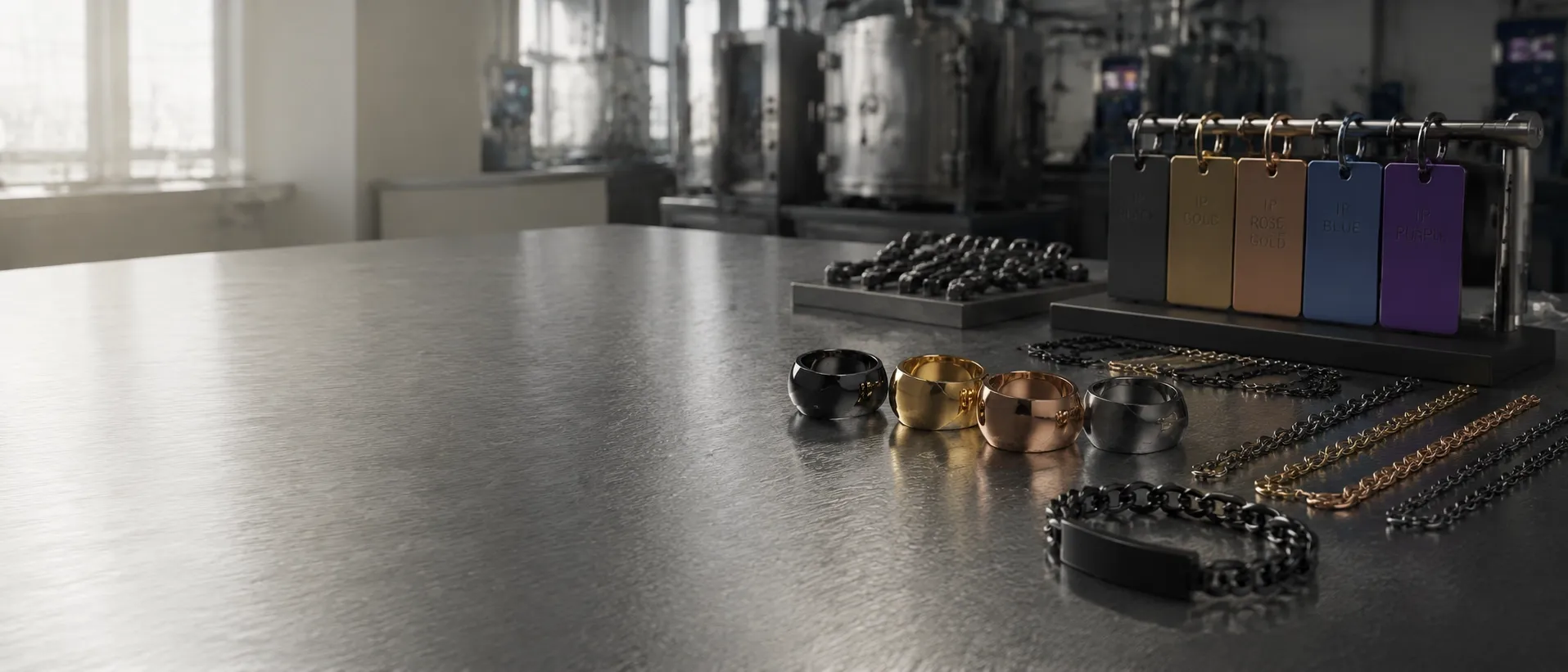
PVD and IP coating
In a vacuum chamber, a solid target is vaporised and the vapour condenses onto the piece as a ceramic compound — usually titanium nitride and its relatives — bonded at the atomic level.
- Tolerance
- ±0.1 µm on coating thickness
- Min. wall
- n/a
- Tooling
- None — chamber batch
- Batch fit
- Batches of one colour
How it works
In a vacuum chamber, a solid target is vaporised and the vapour condenses onto the piece as a ceramic compound — usually titanium nitride and its relatives — bonded at the atomic level.
Gold, rose gold, black and gunmetal on stainless steel — the finish for everyday wear are the work this route is chosen for. It runs on 316L stainless steel, Titanium and suits batches of one colour.
Production steps
Each step below is a separate labour operation, and labour is priced per operation rather than per piece. That is why a 6-step route costs what it does.
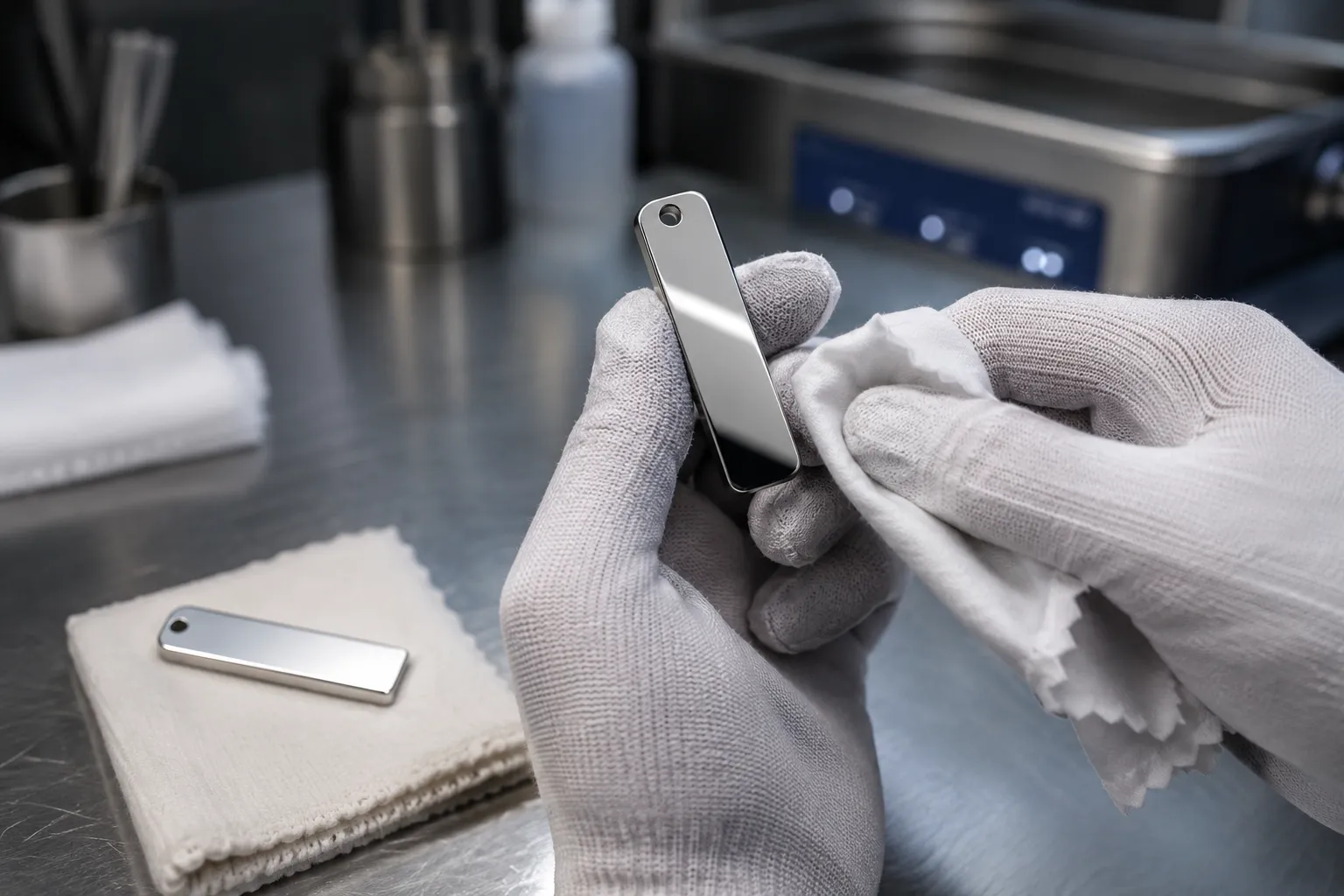
Parts polished to final finish and ultrasonically cleaned 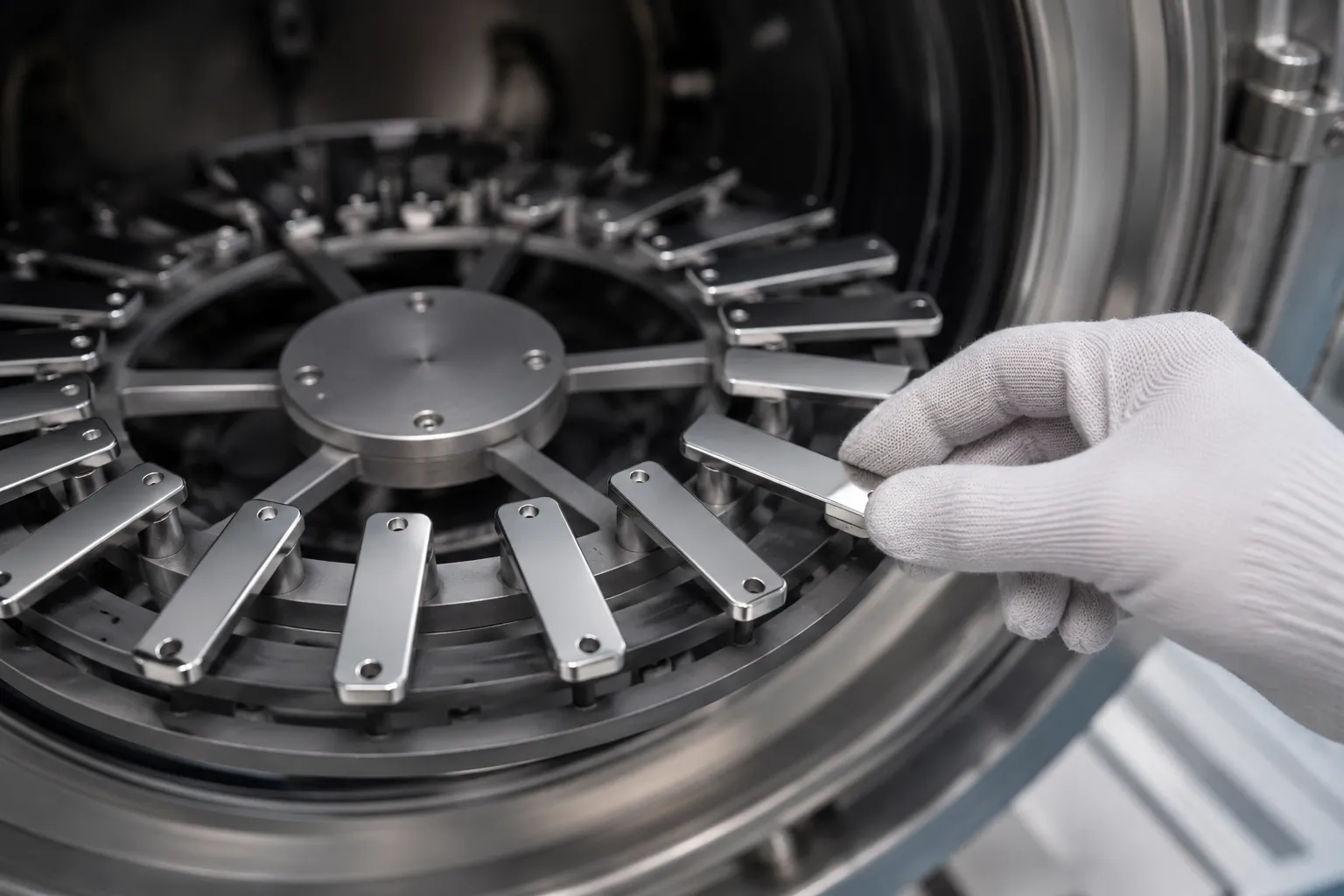
Loaded onto rotating fixtures in the chamber 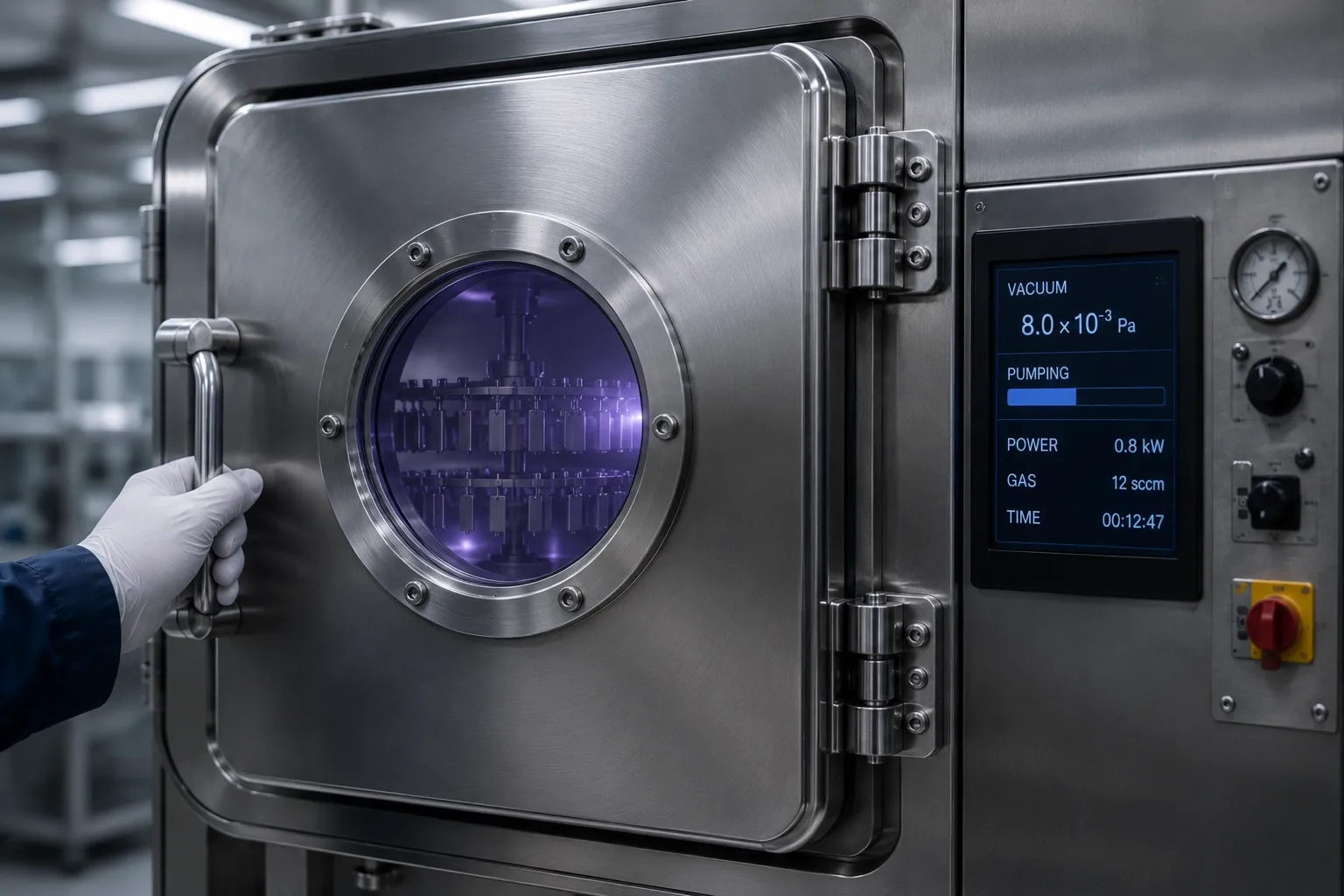
Chamber evacuated and parts ion-etched 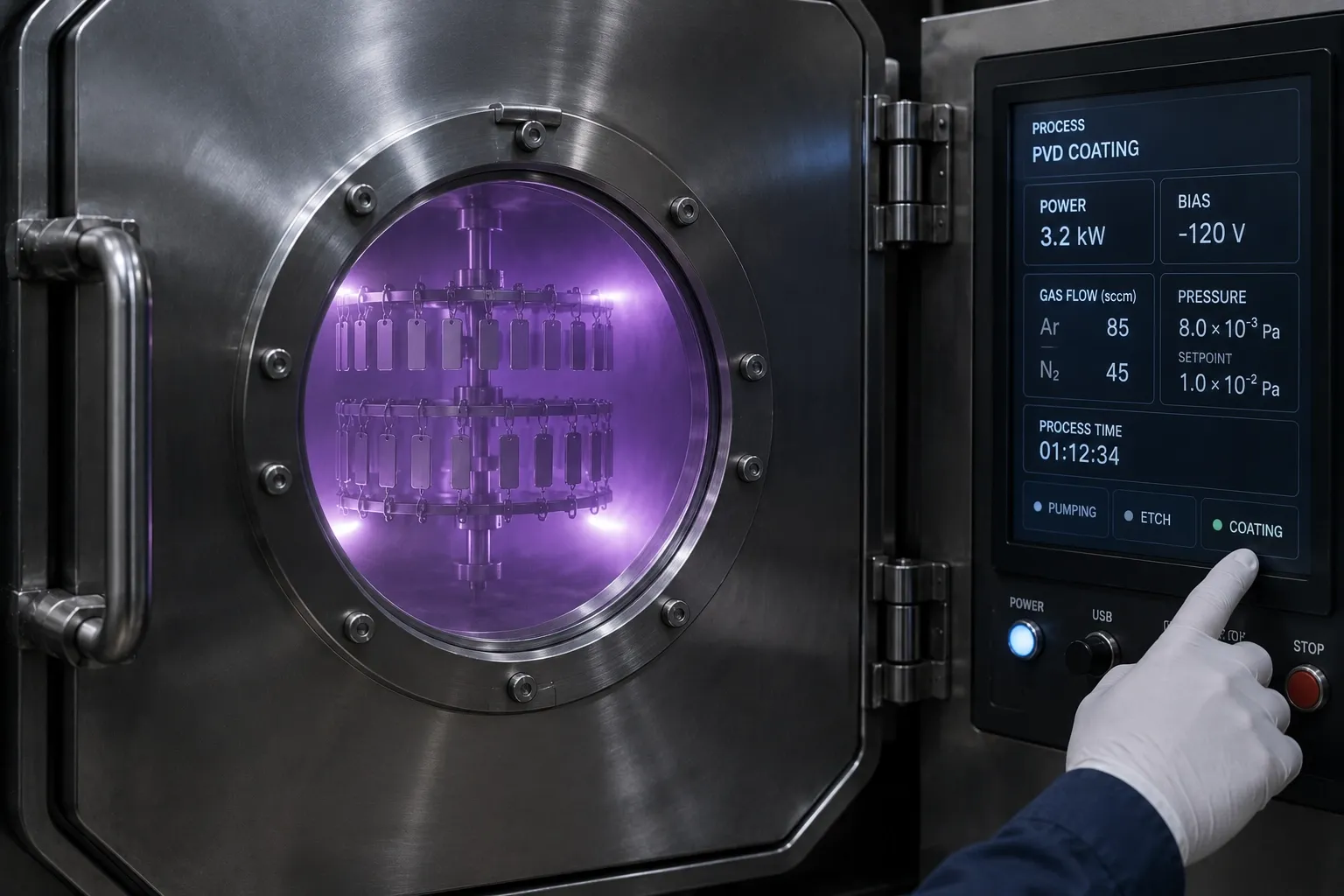
Target vaporised; reactive gas admitted to set the colour 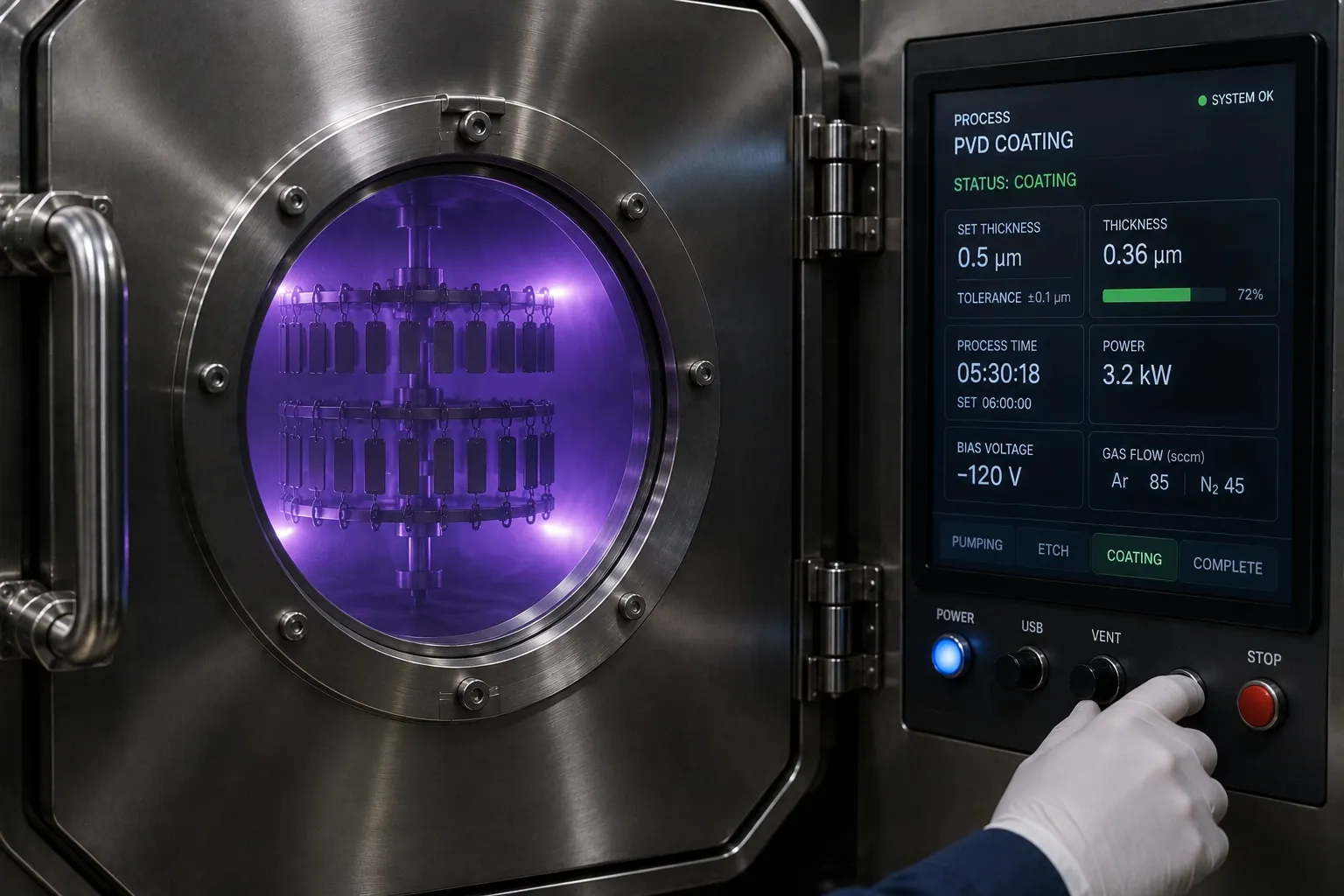
Coating deposited to the specified thickness 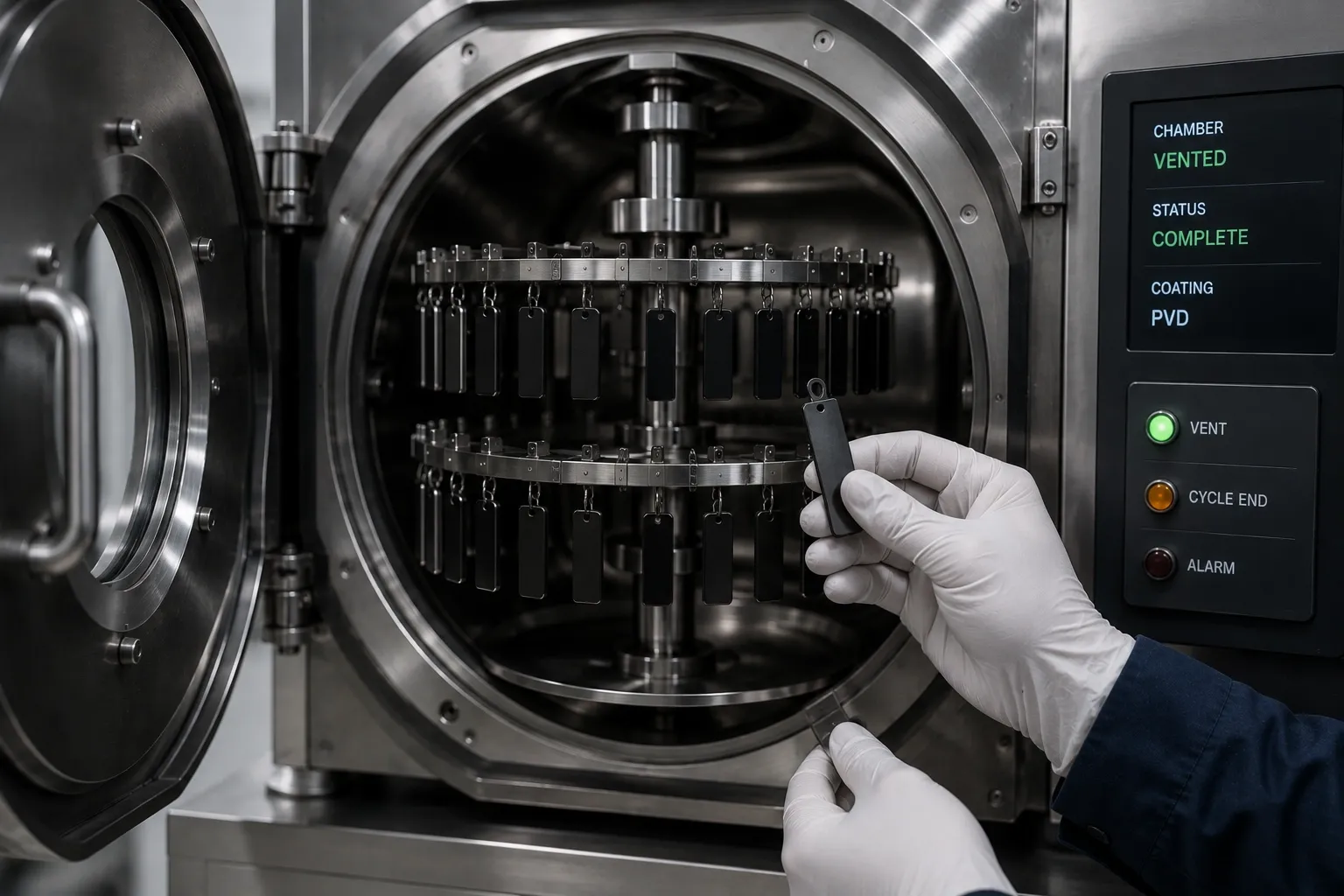
Chamber vented and parts inspected for colour uniformity
Process parameters
These are engineering properties of the process itself. They hold at any competent factory and can be checked against a manufacturing reference.
| Dimensional tolerance | ±0.1 µm on coating thickness |
|---|---|
| Minimum wall / section | n/a |
| Tooling cost | None — chamber batch |
| Suited to | Batches of one colour |
| Cycle time | 4–8 hours per chamber run |
| Materials accepted | 316L stainless steel, Titanium |
Tooling ranges are industry-typical. A firm figure is quoted against your CAD file — see the cost breakdown.
PVD vs Electroplating
Choose PVD when the piece must survive years of daily wear; choose electroplating when the colour range, the substrate or the budget rules PVD out.
Compare with electroplating →Materials and categories this suits
Process, material and product category are one decision seen from three sides. These are the combinations that actually work.
| 316L steel | ASTM A276 / EN 1.4404 |
|---|---|
| Titanium | ASTM B348 Gr.2 / Gr.5 (Ti-6Al-4V) |
| Rings | Gold and black that survives daily wear |
|---|---|
| Bracelets & Bangles | Wear-resistant colour on high-contact surfaces |
| Chains | Gold and black on steel chain |
What to watch out for
PVD and IP coating — buyer questions
Each answer stands alone and can be read without the rest of this page.
What tolerance can pvd and ip coating hold?
PVD and IP coating holds ±0.1 µm on coating thickness on production parts, with a minimum wall or section of n/a. In a vacuum chamber, a solid target is vaporised and the vapour condenses onto the piece as a ceramic compound — usually titanium nitride and its relatives — bonded at the atomic level. Tighter tolerances than this normally mean a secondary machining operation rather than a change to the primary process.
How much does tooling cost for pvd and ip coating?
Tooling for this route is none — chamber batch, quoted as a one-off line and invoiced separately from the unit price. The buyer owns the tooling and it is not charged again on a reorder. Full tooling ranges for every route are on the manufacturing cost page.
What order quantity does pvd and ip coating suit?
This route suits batches of one colour. Below that range the setup cost dominates the unit price; above it, a different route is usually cheaper per piece. Choose PVD when the piece must survive years of daily wear; choose electroplating when the colour range, the substrate or the budget rules PVD out.
Which metals can be processed this way?
316L stainless steel, Titanium. Zinc alloy cannot take PVD. The chamber runs hotter than Zamak's 381–387 °C melting point, so anything sold as "PVD zinc alloy" is electroplated. PVD also cannot cover a poor polish — the coating follows the surface underneath exactly.
PVD or electroplating — which is right for my design?
Choose PVD when the piece must survive years of daily wear; choose electroplating when the colour range, the substrate or the budget rules PVD out.
Not answered here? All buyer questions →
Quote a pvd run
Send the CAD file or a sketch. You get the tooling cost as its own line, the unit price at your quantity, and a straight answer on whether pvd is the right route for the design — we will say so if it is not. Production runs in Qingxi, Dongguan, Guangdong.
- 01Reply within one working day, Guangdong business hours.
- 02Itemised cost sheet — mold quoted separately, not folded into the unit price.
- 03NDA on request before any file is shared.