
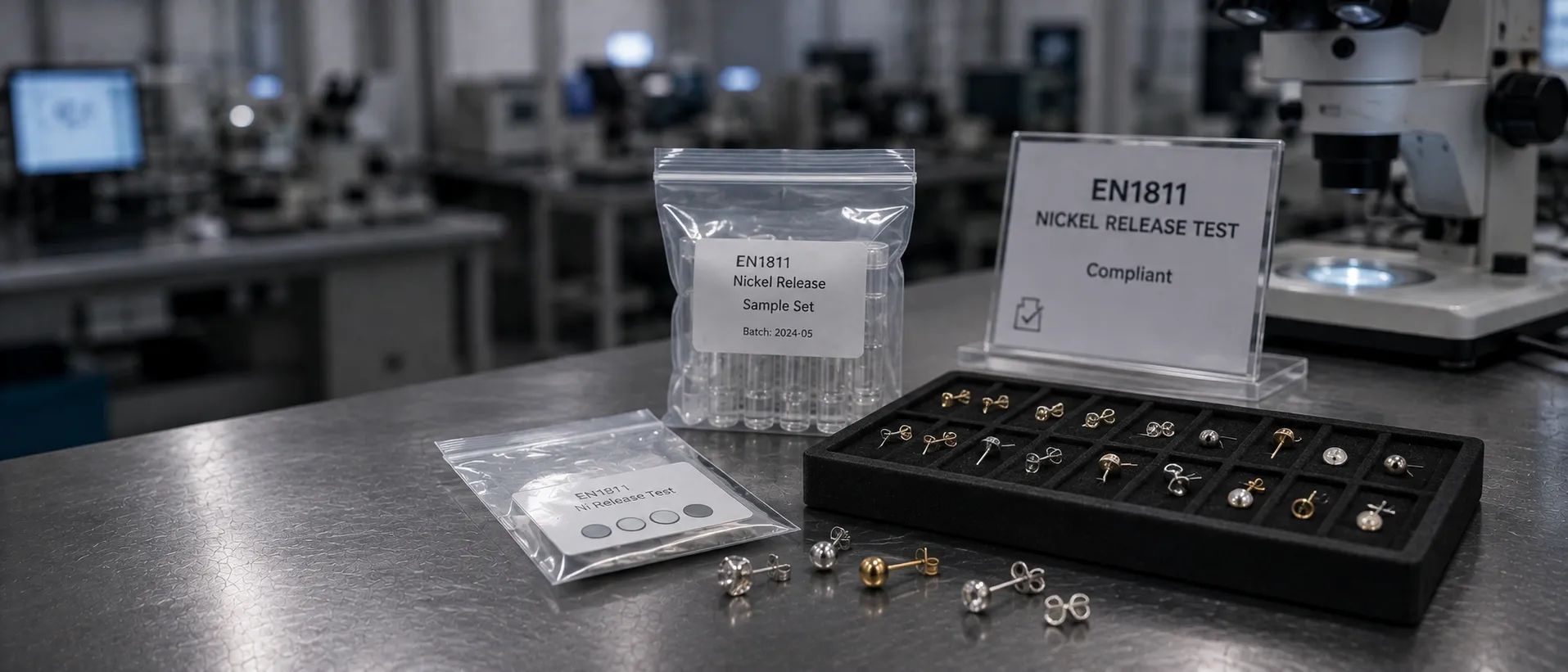
What is the EN 1811 nickel release limit, and which metals pass it?
Nickel allergy is the most common contact allergy in Europe, and the EU regulates it by limiting how much nickel a product releases onto skin — not how much it contains. That distinction produces results most buyers find backwards: the alloy with the most nickel on this page passes, and a plated piece with far less fails.
The two limits
One regulation, two thresholds, decided by how the product contacts the body. Getting the wrong one applied to a product is how a compliant-looking range becomes unsellable at the border.
| Application | Limit | Test method | Examples |
|---|---|---|---|
| Inserted into a pierced body part | 0.2 µg/cm²/week | EN 1811 | Earring posts and hoops, nose studs, body piercing jewelry |
| Prolonged contact with skin | 0.5 µg/cm²/week | EN 1811, after EN 12472 for coated items | Rings, bracelets, necklaces, watch cases, chains, buttons, rivets |
| Coated items, over service life | The applicable limit must still hold after 2 years of normal use | EN 12472 wear simulation, then EN 1811 | Any plated or PVD-coated piece |
Limits are set by REACH Annex XVII entry 27 and are identical for every supplier. 'Prolonged' is defined in the regulation as more than 10 minutes on three or more occasions within two weeks, or more than 30 minutes once.
Release is not content
Everything counter-intuitive about nickel compliance follows from this one point. The regulation measures what comes off the surface onto skin, not what is in the metal.
Nickel dissolves out of a surface when sweat — which is mildly acidic and contains chloride — sits against it. How much dissolves depends on how the nickel is bound, not on how much of it is present.
In 316L stainless steel, nickel is a structural component of an austenitic crystal lattice, held in solid solution and protected by a chromium oxide film that re-forms within seconds of being scratched. It does not readily leave. The alloy contains 10–14% nickel and releases far below the limit.
In a nickel-plated brass piece, nickel is a discrete metallic layer sitting immediately under the decorative gold — perhaps 2% of the piece by weight, and positioned exactly where skin contact happens once the thin gold layer wears through. It releases readily and fails.
The counter-intuitive result is that the highest-nickel metal on this site passes, and one of the lowest-nickel constructions fails.
How the test works
Understanding the sequence matters commercially, because the most common way to obtain a meaningless pass is to skip the conditioning step.
| Stage | Standard | What happens | Why it matters |
|---|---|---|---|
| 1 · Wear simulation | EN 12472 | Coated samples are abraded and corroded to simulate two years of normal wear | A freshly plated sample releases almost nothing — this step is what makes the result meaningful |
| 2 · Immersion | EN 1811 | Sample immersed one week in artificial sweat at 30 °C, pH 6.5 | Reproduces the chemistry that actually dissolves nickel from a surface |
| 3 · Analysis | EN 1811 | Solution analysed for dissolved nickel, result normalised to surface area | Gives the µg/cm²/week figure the regulation is written in |
| 4 · Comparison | REACH XVII-27 | Result compared against 0.2 µg/cm²/week or 0.5 µg/cm²/week | The threshold applied depends on the product type, not on the material |
Testing is arranged on request against the standards a destination market requires. Which tests apply, what they cost and how long they take depend on the standard, the laboratory and the batch, so both are confirmed in writing in the quotation.
Which metals pass
Behaviour by base metal, before any plating is applied. Plating changes the answer for every row in the lower half of this table.
| Material | Nickel content | Release behaviour | Pierced ears | Skin contact |
|---|---|---|---|---|
| Stainless steel 316L | 10–14% | Below both limits | Passes | Passes |
| Titanium (Grade 2 / Grade 5) | None as an alloy | Below both limits | Passes | Passes |
| Sterling silver 925 | None as an alloy | Below both limits | Passes | Passes |
| Brass (C2600 / C3604) | None as an alloy | Determined by the plating barrier | Nickel-free barrier required | Nickel-free barrier required |
| Zinc alloy (Zamak 3 / 5) | None as an alloy | Determined by the plating barrier | Nickel-free barrier required | Nickel-free barrier required |
| Copper & bronze | None as an alloy | Determined by the plating barrier | Nickel-free barrier required | Nickel-free barrier required |
Bare-metal behaviour. Any electroplated finish introduces a barrier layer whose composition must be specified — see the next section.
Plating is where nickel enters
A nickel-free alloy plated by the default process is not a nickel-free product. This is the single most common route to a failed batch.
Electroplating gold onto brass requires an intermediate barrier layer. It stops copper from the brass migrating into the gold and discolouring it, and it gives the gold a surface to adhere to. The industry default barrier is nickel, because it does that job well and costs little.
That barrier sits directly beneath the gold — micrometres from skin, and exposed entirely once the gold wears through at a contact point. A brass earring that is nickel-free as an alloy becomes a nickel-release failure through its finishing.
Nickel-free barriers exist: palladium, copper strikes and specialised proprietary systems. They cost more and must be specified in the purchase order, because no supplier substitutes them by default.
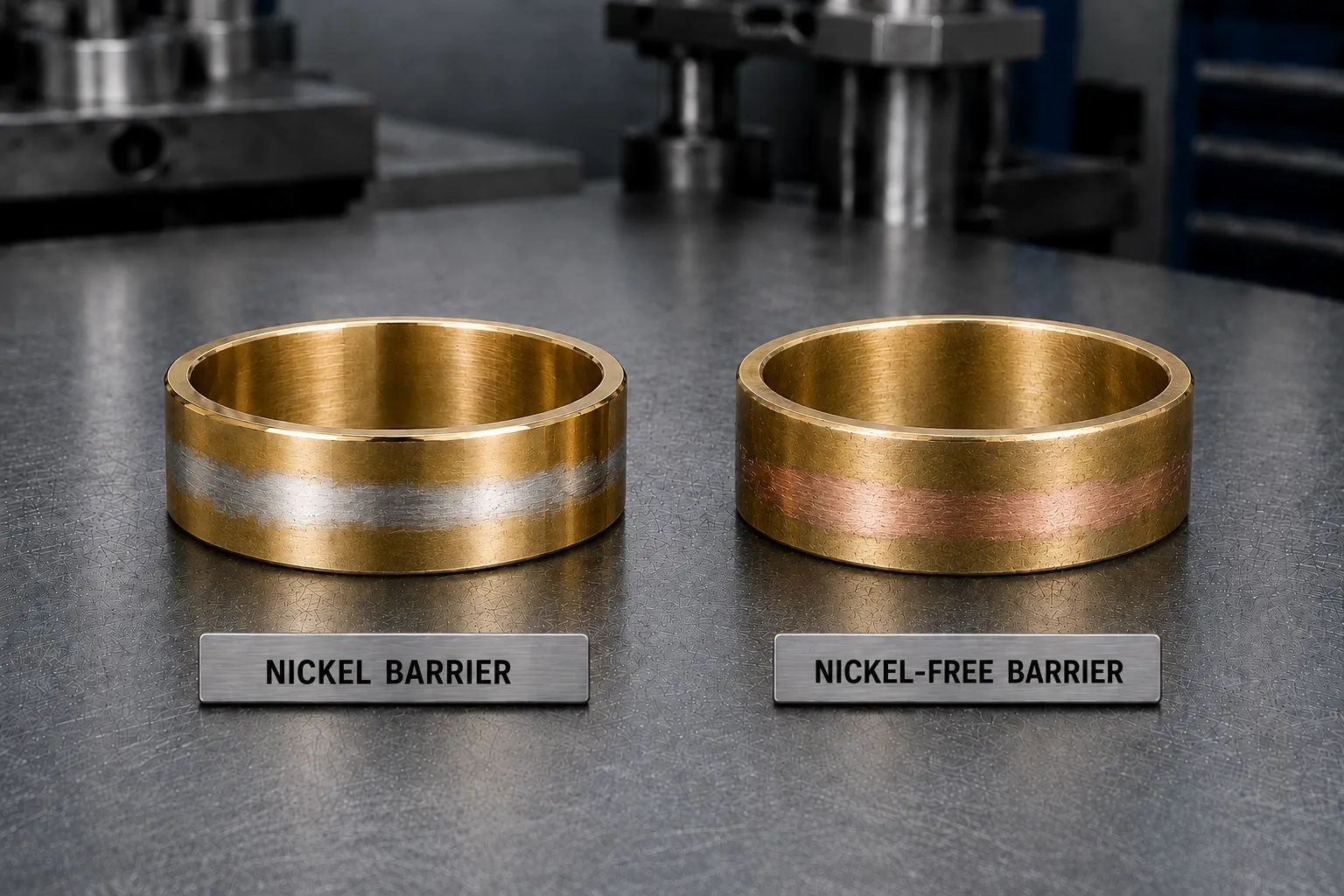
| Barrier layer | Cost | Nickel exposure | Suitable for pierced ears |
|---|---|---|---|
| Nickel (industry default) | $ | High once the top layer wears | No |
| Palladium | $$$ | None | Yes |
| Copper strike | $$ | None from the barrier itself | Yes, with a suitable top layer |
| No barrier — direct on 316L | $ | None | Yes |
| PVD on 316L or titanium | $$$ | None — ceramic coating, no metallic barrier | Yes |
PVD on stainless steel avoids the barrier problem entirely, because the coating is a ceramic compound bonded to a substrate that already passes on its own.
By product category
The limit that applies is decided by product shape, and the practical difficulty of meeting it varies more than the limit does.
| Category | Applicable limit | Difficulty | Safest specification |
|---|---|---|---|
| Custom rings | 0.5 µg/cm²/week | Moderate | 316L, titanium, or a nickel-free barrier |
| Custom necklaces and pendants | 0.5 µg/cm²/week | Moderate | 316L, titanium, or a nickel-free barrier |
| Custom earrings | 0.2 µg/cm²/week | Highest — strictest limit, smallest parts | Titanium or 316L posts |
| Custom bracelets and bangles | 0.5 µg/cm²/week | Moderate | 316L, titanium, or a nickel-free barrier |
| Custom chains | 0.5 µg/cm²/week | High — very large surface area per gram | 316L or 925 silver, unplated or PVD |
| Custom cufflinks and men's accessories | Intermittent contact — applied less stringently | Moderate | 316L, titanium, or a nickel-free barrier |
Chain is the hardest form to certify with plated base metal because its surface area per gram is far higher than a solid piece of the same weight.
What to specify in the purchase order
Compliance is decided at specification stage, not at inspection stage. These six lines cost nothing to add and prevent almost every nickel failure.
| Base metal | Grade designation, e.g. 316L to ASTM A276 — not "stainless steel" |
|---|---|
| Barrier layer | Nickel-free (palladium or copper strike) for EU-bound and pierced-ear items |
| Coating thickness | In microns, not by colour name |
| Applicable limit | 0.2 µg/cm²/week for pierced ears, 0.5 µg/cm²/week for skin contact |
| Test method | EN 1811, with EN 12472 conditioning for coated items |
| Batch coverage | Which production batches are tested, and who bears the cost |
| Findings | Clasps, posts and extenders held to the same standard as the body |
Third-party testing is arranged on request. Which standards apply, what the laboratory charges and how long it takes depend on the market, the material and the batch size, so both are confirmed in writing in the quotation rather than quoted generically.
Common misconceptions
Questions buyers ask about this
Each answer is self-contained and can be read without the rest of the page.
What is the EN 1811 nickel release limit for jewelry?
Two limits apply under REACH Annex XVII entry 27. Items intended to be inserted into pierced ears or other pierced parts of the body are limited to 0.2 µg/cm²/week of nickel release. Items in prolonged contact with skin — rings, bracelets, necklaces, watch cases, buttons and rivets — are limited to 0.5 µg/cm²/week. Both are measured by the EN 1811 reference test method, and the limit must continue to hold after two years of normal use.
Is 316L stainless steel nickel-free?
No — 316L contains 10–14% nickel by composition. It nevertheless passes EN 1811 comfortably, because the alloy is austenitic and the nickel is locked into the crystal structure rather than being free at the surface to dissolve into sweat. This is the single most misunderstood point in jewelry compliance: the regulation limits release, not content, and those two things do not correlate.
Which jewelry metals are genuinely nickel-free?
Titanium is nickel-free by composition, which is why it is the default specification for pierced-ear posts. Sterling silver at 925 fineness is nickel-free — 92.5% silver with copper as the balance. Brass, zinc alloy, copper and bronze are all nickel-free as alloys, but conventional electroplating puts a nickel barrier layer directly beneath the visible surface, which is exactly where skin contact occurs.
What is EN 12472 and why does it matter for plated jewelry?
EN 12472 is a wear-and-corrosion simulation applied to coated items before the EN 1811 release test is run. It exists because a freshly plated piece releases almost no nickel — the barrier is sealed under the colour layer — while the same piece after months of wear may have worn through. Testing a new plated sample without EN 12472 conditioning produces a pass that means nothing about the product in the customer's hands.
Does a nickel test report cover every batch?
No, and this is a real commercial exposure. A test report certifies the batch that was sampled. Plating chemistry, bath age and layer thickness vary between production runs, so a report from an earlier order is evidence of capability rather than proof of compliance for the current one. For regulated markets, agree at quotation stage which batches get tested and who pays.
Do these limits apply outside the EU?
The 0.2 and 0.5 µg/cm²/week limits are EU and UK law under REACH Annex XVII entry 27. The United States regulates jewelry primarily on lead and cadmium rather than nickel — see California Prop 65 and the CPSIA. Several other markets reference the EN 1811 method in their own rules. Ship into the EU or the UK and these limits apply regardless of where the product was made.
Not answered here? All buyer questions →
Get the number for your actual order
The ranges on this page are the structure. A quotation puts your design, quantity, material and finish into it and returns a single itemised figure.
- 01Reply within one working day, Guangdong business hours.
- 02Itemised cost sheet — mold quoted separately, not folded into the unit price.
- 03NDA on request before any file is shared.