
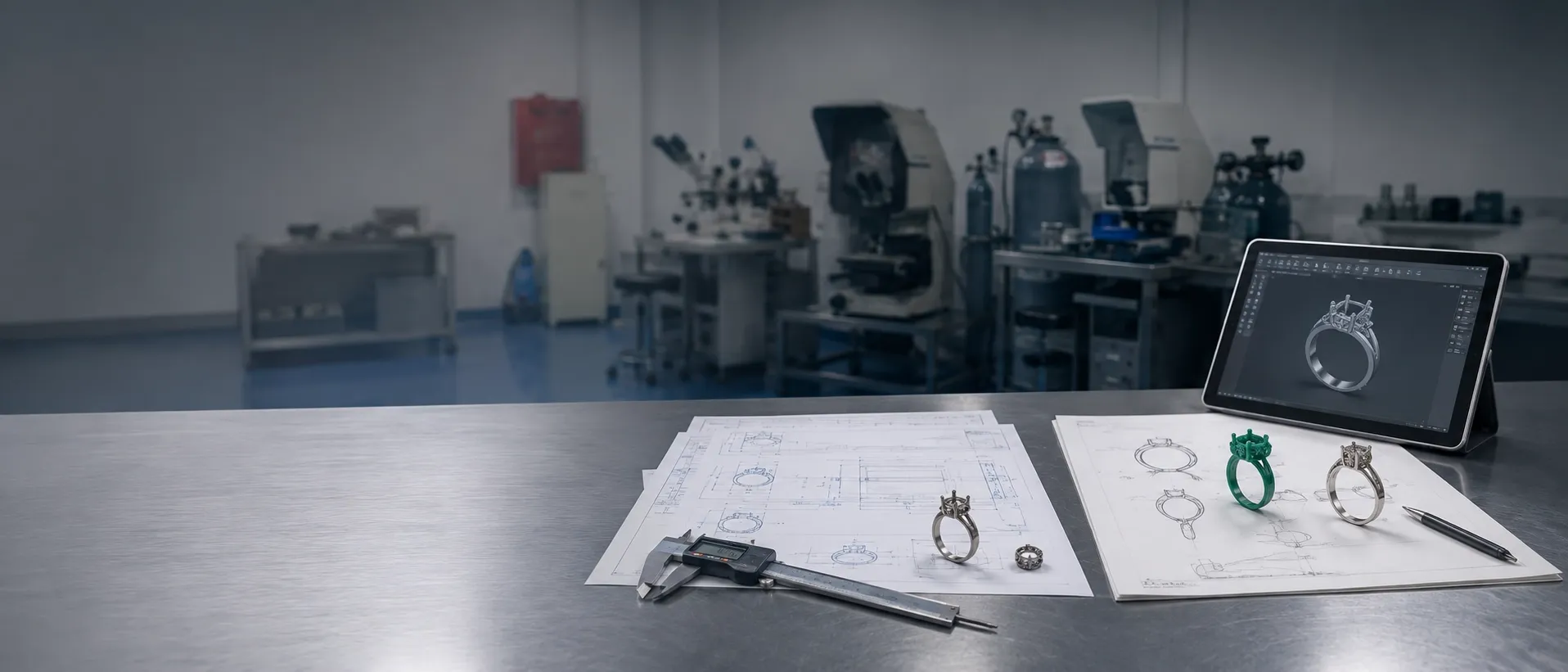
What is the difference between OEM and ODM in jewelry?
OEM and ODM are used interchangeably across most supplier websites, and they describe genuinely different arrangements with different costs, timelines and ownership consequences. The distinction is simple: OEM means you bring the design, ODM means the factory develops it.
- MOQ
- 500 pcs / style / colour
- Sampling
- 10 days
- Production
- 25 days
- Tooling
- Separate one-off line
Who this suits
- OEM — brands with an in-house or contracted designer producing finished CAD
- ODM — brands with a clear brief and a market position but no design resource
- Retailers building an own-label range from a category concept rather than a drawing
- Buyers testing a new category who need development speed more than design control
What each side supplies
Most delays on a first order come from an unstated assumption about who provides what. This is the split.
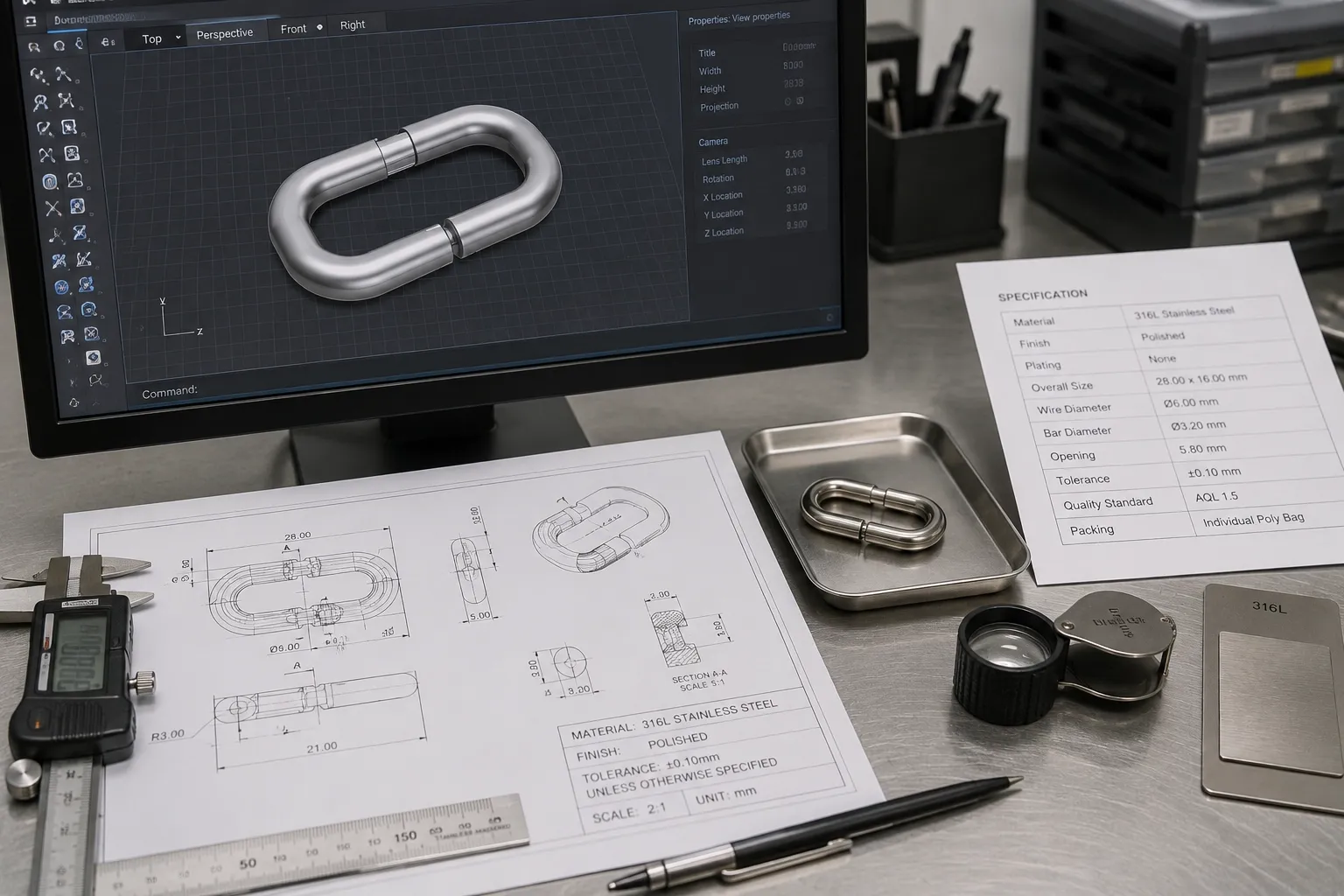
- OEM: complete design, materials, finish and tolerances
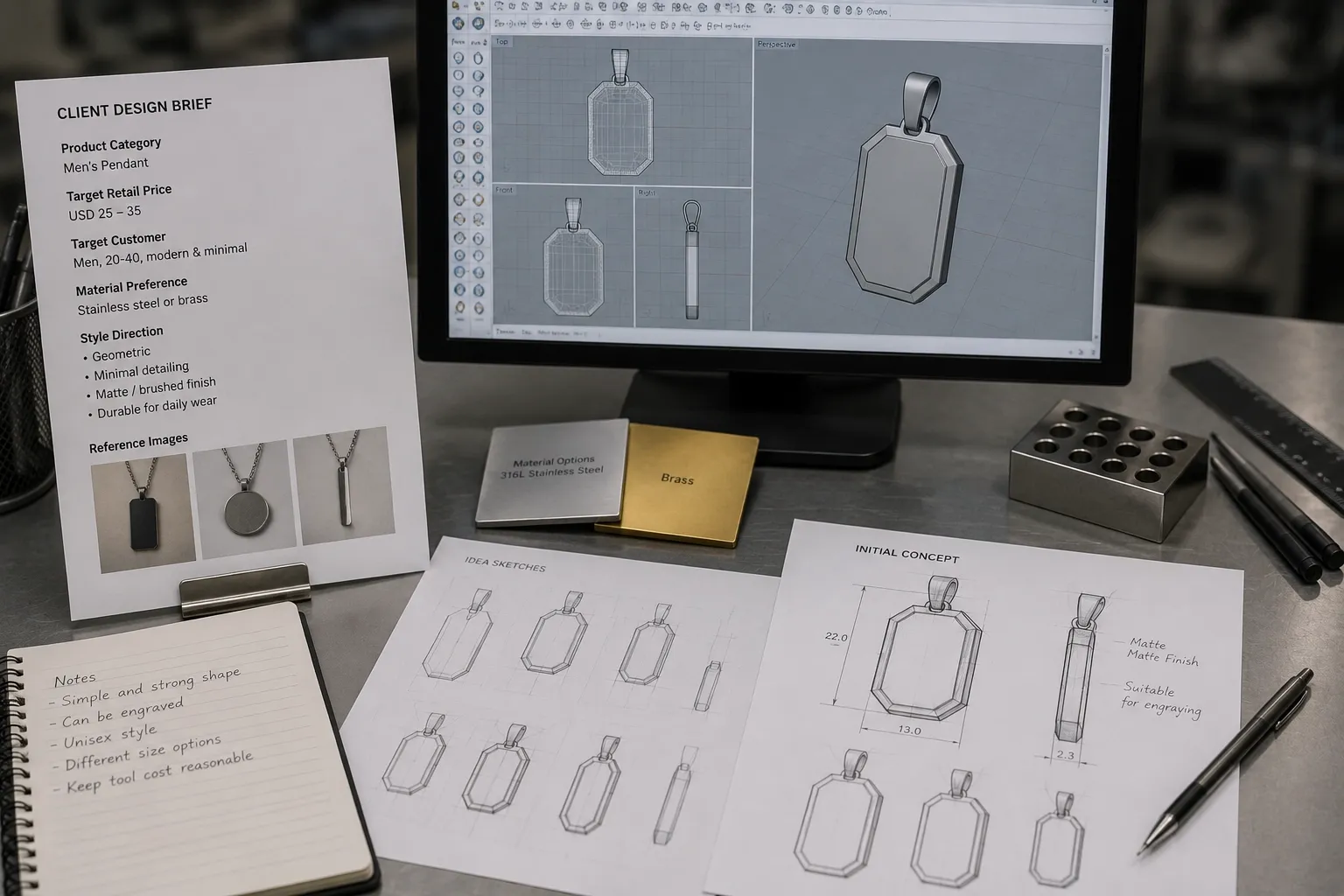
- ODM: a written brief — category, price point, target customer, reference pieces
- Both: quantity, target market and launch date
- Both: approval decisions at CAD and at physical sample
- OEM: manufacturability review, tooling, production
- ODM: concept development, CAD, materials proposal and costing to your price point
- Both: sampling, production, inspection, documentation
- Both: an NDA before files or briefs are exchanged
How it runs
Each stage has a duration attached. Tooling time runs before sampling, not inside it, so a launch date is built from the sum rather than from the production figure alone.
- 01
≤ 24 hBrief or design inOEM: CAD reviewed for manufacturability. ODM: brief reviewed and a concept direction agreed.
- 02
5–10 daysDevelopmentODM only — concepts, then CAD developed to your price point and market.
- 03
1–2 daysQuotationItemised, with tooling and any development cost shown as separate lines.
- 04
2–20 daysToolingCut after written CAD sign-off.
- 05
10 daysSamplingPhysical sample for approval before bulk.
- 06
25 daysProductionIn-line QC, AQL inspection report on completion.
Order terms
| MOQ | 500 pcs per style, per plating colour |
|---|---|
| Sampling | 10 days from approved 3D file |
| Bulk production | 25 days after sample approval |
| Tooling | Quoted and invoiced as a separate one-off line — buyer owns it |
| Reorder | No second tooling charge for the same design |
| NDA | Signed before design files or briefs are received |
| Inspection | AQL inspection report travels with the shipment |
| Testing | Arranged on request against the destination market’s standards |
How this differs from the other routes
OEM: you supply the design, the factory manufactures it, and you own the design outright from the start. ODM: the factory develops the design from your brief, and who owns the resulting design is a matter of contract — which is exactly why it should be settled in writing before development begins rather than after you have committed to the range.
| Route | Who designs | Tooling cost | Lead time | Exclusive to you? |
|---|---|---|---|---|
| Custom / OEM | You | Yes — separate line | Longest — tooling before sampling | Yes |
| ODM | The factory, from your brief | Yes, plus development | Longest — development, then tooling | Only if agreed in writing |
| Private label | Already designed | None | Shortest — ~25 days | No |
What to watch out for
OEM and ODM jewelry manufacturing — buyer questions
Each answer stands alone and can be read without the rest of this page.
What is the difference between OEM and ODM jewelry manufacturing?
OEM — original equipment manufacturing — means the buyer supplies a finished design and the factory produces it. ODM — original design manufacturing — means the factory develops the design from the buyer's brief. The practical consequences are cost, timeline and ownership: ODM adds a development stage of roughly 5–10 days and a development cost, and it raises a design-ownership question that OEM does not.
Who owns the design in an ODM arrangement?
It depends entirely on what the agreement says, which is why it must be settled before development starts. In many supply relationships the default is that the factory retains a design it developed and may offer it to other buyers. If exclusivity matters to the brand, the agreement needs to say so explicitly and state the term.
Does ODM cost more than OEM?
It carries a development cost that OEM does not, because CAD work and concept iteration are real labour. Against that, ODM development is designed around your target price from the beginning, so it often reaches a manufacturable, on-budget design faster than a design produced without knowledge of manufacturing constraints. The unit price itself does not differ by route.
Can I start with ODM and move to OEM later?
Yes, and it is a common path. A brand uses ODM to launch a first range while it has no design resource, then brings design in-house and switches to OEM for later collections. What makes the transition clean is having settled design ownership at the start, so the earlier designs move with the brand.
What should an ODM brief contain?
Category and style direction, target retail and landed price, target customer, the market you ship to, quantity per style, and three to five reference pieces with a note on what you like about each. The price point and the target market are the two that constrain the design most, because they set the material and the compliance route before any drawing exists.
Is private label the same as OEM?
No. Private label applies your brand to an existing design — the fastest and cheapest route, with no tooling and no development, but no design exclusivity. OEM produces a design you own. The three routes trade speed against control, and most brands use more than one at different points.
Not answered here? All buyer questions →
Get a quote in one working day
Send the design or the brief, the material and the quantity. You get an itemised price, the tooling cost as its own line, and a manufacturability review before anything is committed. Production runs on our own floor in Qingxi, Dongguan, Guangdong.
- 01Reply within one working day, Guangdong business hours.
- 02Itemised cost sheet — mold quoted separately, not folded into the unit price.
- 03NDA on request before any file is shared.