
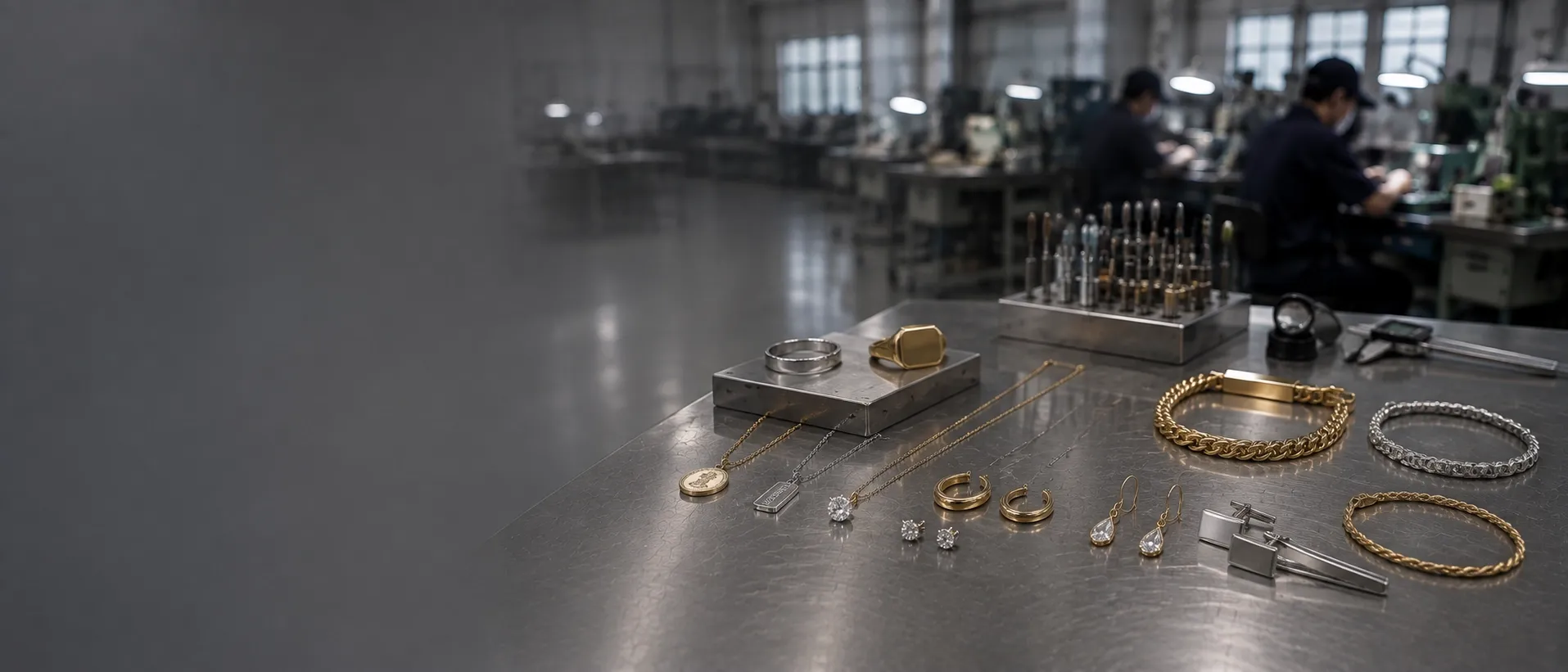
What do you need to specify for each jewelry category?
Product shape decides which regulation bites, which forming route applies, and which dimensions a quotation needs before it can be written. Earrings are held to a nickel-release limit two and a half times stricter than rings; chains fail on a mechanical property no photograph shows. This page sets out those differences by category.
All six categories compared
What differs between categories is not manufacturing difficulty — it is which regulation applies, which forming route suits the shape, and which dimensions must be specified before a price exists.
| Category | First-choice metal | Main processes | Nickel limit | Key specification |
|---|---|---|---|---|
| Custom rings | 316L stainless steel | CNC machining, Lost-wax casting | 0.5 µg/cm²/week | Size range — US 4–14 · UK H–Z+4 · EU 47–73 |
| Custom necklaces and pendants | 316L stainless steel | Lost-wax casting, Stamping | 0.5 µg/cm²/week | Chain lengths — 35 / 40 / 45 / 50 / 55 / 60 / 70 cm |
| Custom earrings | Titanium | Stamping, Lost-wax casting | 0.2 µg/cm²/week | Post diameter — 0.7–1.0 mm (standard 0.8 mm) |
| Custom bracelets and bangles | 316L stainless steel | Stamping, Chain making | 0.5 µg/cm²/week | Bracelet length — 16 / 17 / 18 / 19 / 20 / 21 cm |
| Custom chains | 316L stainless steel | Chain making, Polishing & finishing | 0.5 µg/cm²/week | Gauge — 0.8–12 mm |
| Custom cufflinks and men's accessories | 316L stainless steel | Stamping, Enameling | Intermittent contact | Cufflink face — 12–20 mm |
Nickel limits are set by REACH Annex XVII entry 27 and measured to EN 1811. The stricter piercing limit applies to earrings specifically, not to jewelry generally.
What a quotation needs
Each category has its own dimensional vocabulary. These are the fields that change either the tooling or the unit price, which is why a quote cannot be written without them.
| Size range | US 4–14 · UK H–Z+4 · EU 47–73 |
|---|---|
| Band width | 2–12 mm |
| Band thickness | 1.2–2.5 mm |
| Comfort fit | Domed interior, adds ~0.25 size |
| Size tolerance | ±0.25 US size |
| Chain lengths | 35 / 40 / 45 / 50 / 55 / 60 / 70 cm |
|---|---|
| Extender chain | 5 cm standard |
| Chain gauge | 0.8–4 mm |
| Pendant size | 8–50 mm |
| Clasp types | Lobster, spring ring, toggle, magnetic |
| Post diameter | 0.7–1.0 mm (standard 0.8 mm) |
|---|---|
| Post length | 9–11 mm |
| Stud face | 3–12 mm |
| Hoop diameter | 8–70 mm |
| Butterfly back | 5–6 mm |
| Bracelet length | 16 / 17 / 18 / 19 / 20 / 21 cm |
|---|---|
| Bangle inner diameter | 55 / 60 / 65 mm |
| Cuff opening gap | 25–35 mm |
| Band width | 3–25 mm |
| Material thickness | 1.0–3.0 mm for cuffs |
| Gauge | 0.8–12 mm |
|---|---|
| Necklace lengths | 40–70 cm |
| Bracelet lengths | 16–21 cm |
| Link closure | Soldered or butted — must be specified |
| Clasp | Lobster, spring ring, box, toggle |
| Cufflink face | 12–20 mm |
|---|---|
| Cufflink back | Bullet, whale, chain, fixed |
| Tie bar length | 40 / 45 / 55 mm |
| Lapel pin | 10–25 mm |
| Material thickness | 1.5–3.0 mm |
Compliance by category
The applicable standard depends on how the product contacts skin. Naming the right one is what lets a buyer plan a range for a market rather than discover a problem at customs.
Testing is arranged on request against whichever standards the destination market requires. Full detail on EN 1811 nickel releaseand California Prop 65.
Order terms
The same terms apply across every category. Tooling is always quoted as its own one-off line and is never amortised into the unit price.
| MOQ | 500 pcs per style, per plating colour |
|---|---|
| Sampling | 10 days from approved 3D file |
| Bulk production | 25 days after sample approval |
| Tooling | Quoted as a separate one-off line — see cost breakdown |
The six categories
Each page carries the style range, material and process options, sizing conventions, customisation options and the compliance limit for that shape.
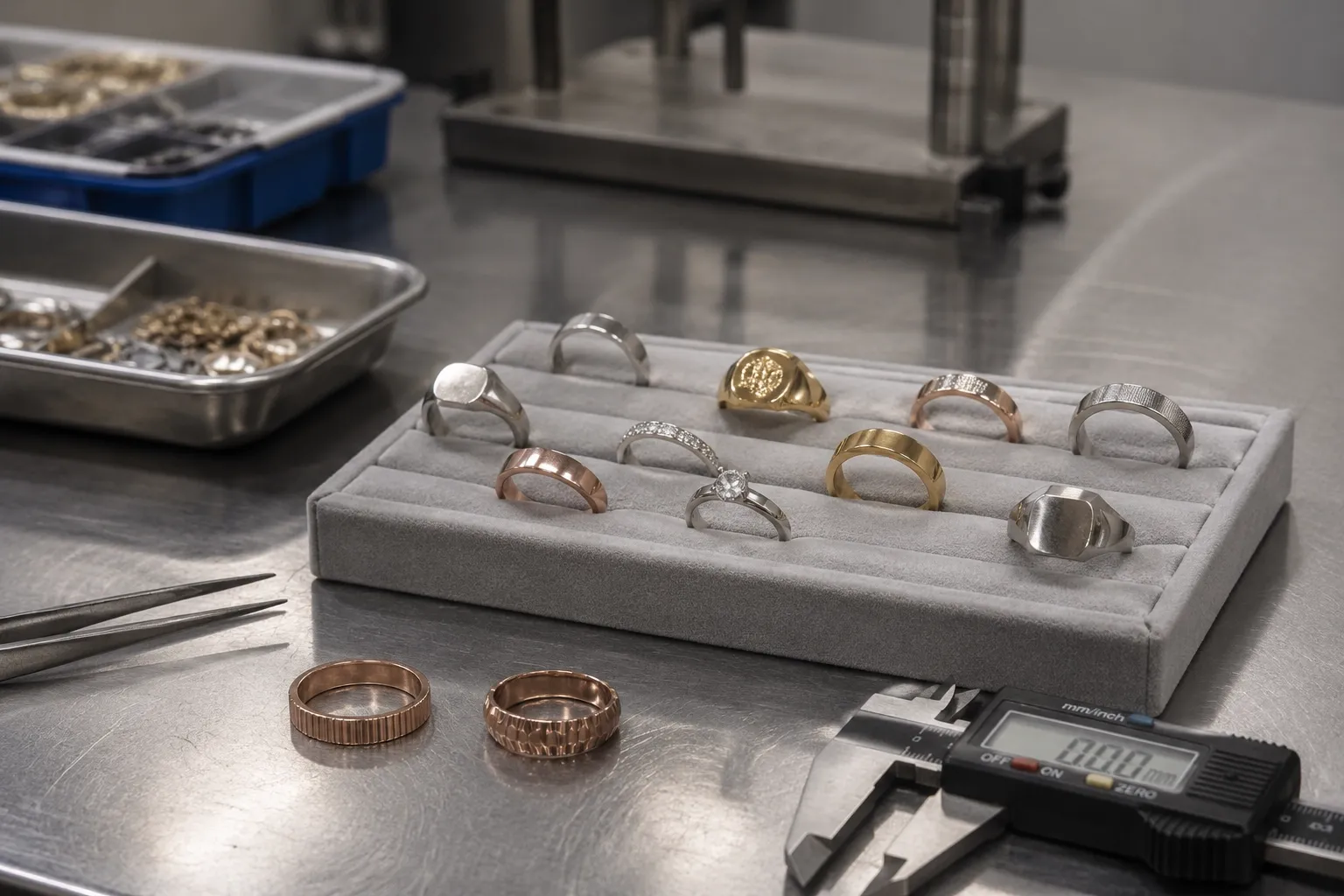
Rings
CAT-01Signet · Plain band · Stacking · Stone-set
- MOQ
- 500 pcs
- First choice
- 316L stainless steel
- Nickel limit
- 0.5 µg/cm²/week
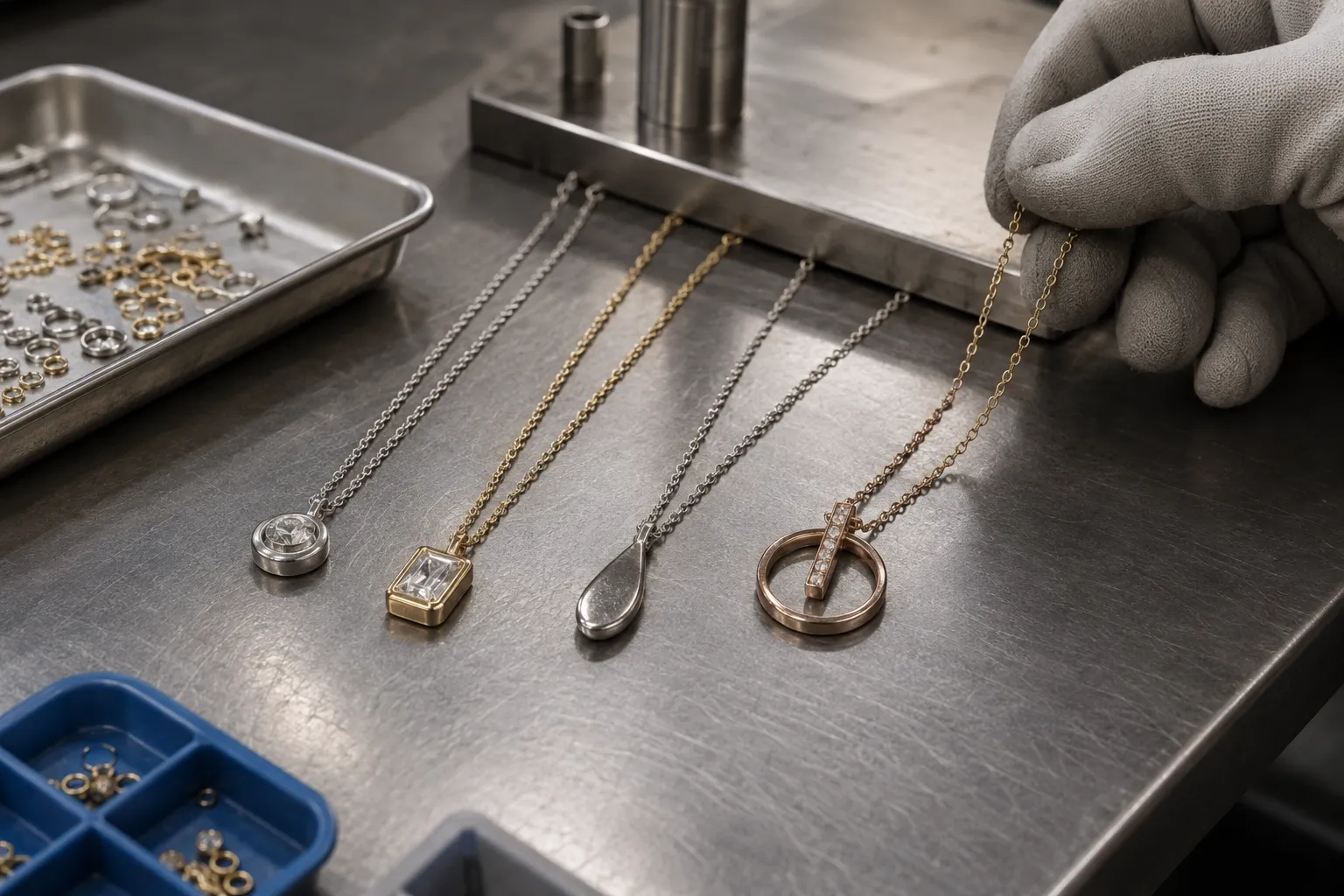
Necklaces & Pendants
CAT-02Pendant on chain · Charm necklace · Bar necklace · Locket
- MOQ
- 500 pcs
- First choice
- 316L stainless steel
- Nickel limit
- 0.5 µg/cm²/week
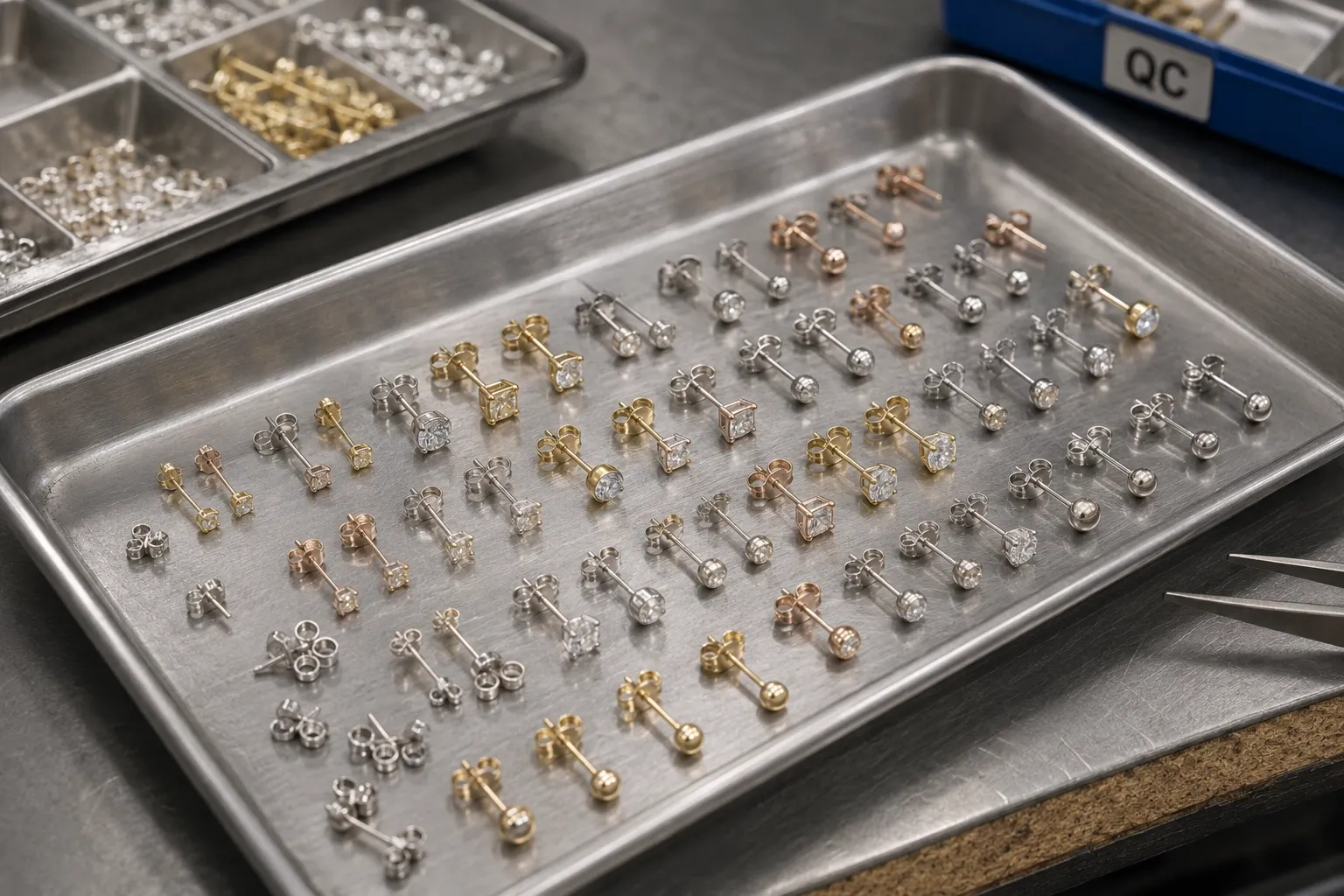
Earrings
CAT-03Studs · Hoops · Huggies · Drops
- MOQ
- 500 pcs
- First choice
- Titanium
- Nickel limit
- 0.2 µg/cm²/week
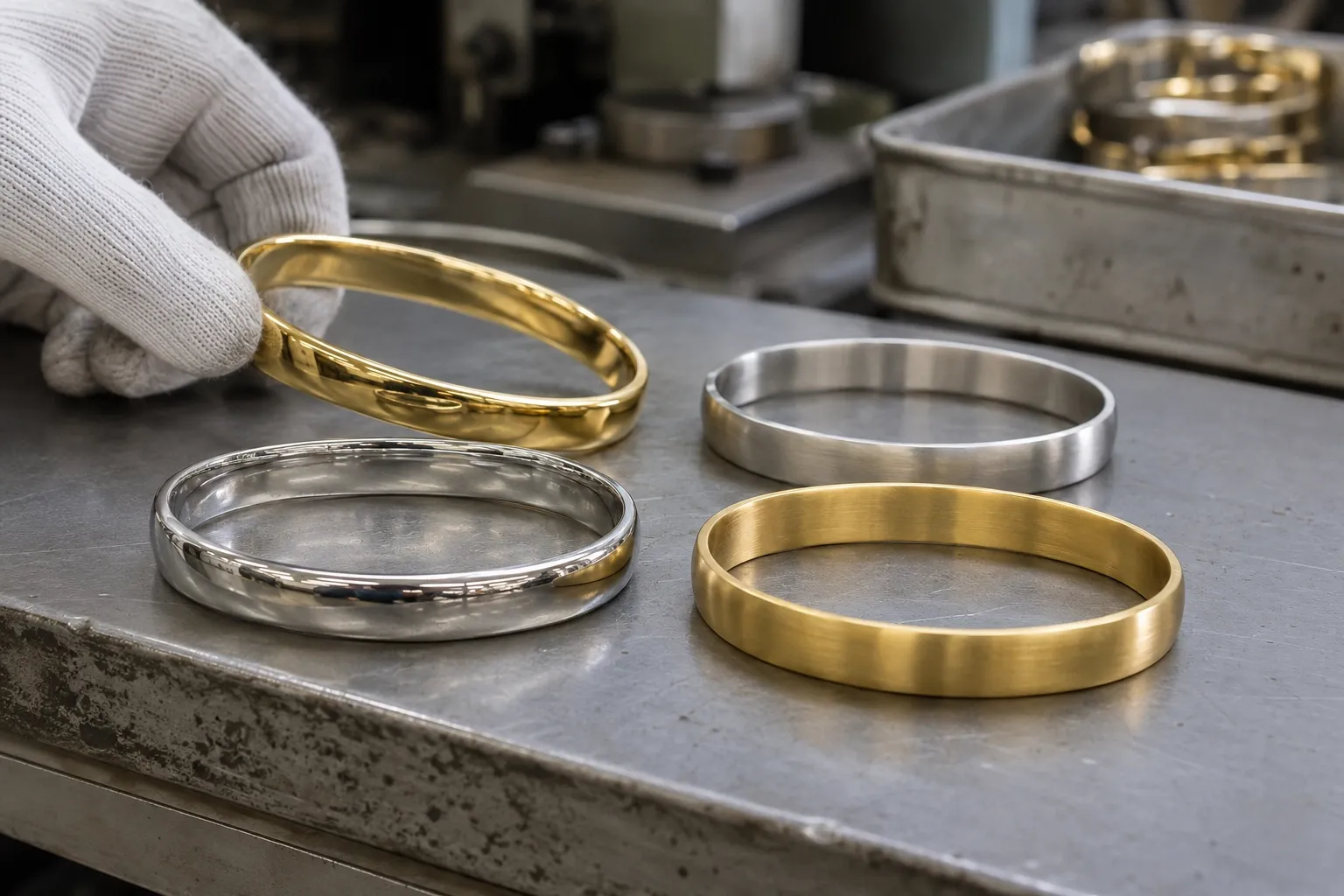
Bracelets & Bangles
CAT-04Cuff · Rigid bangle · Hinged bangle · Link bracelet
- MOQ
- 500 pcs
- First choice
- 316L stainless steel
- Nickel limit
- 0.5 µg/cm²/week
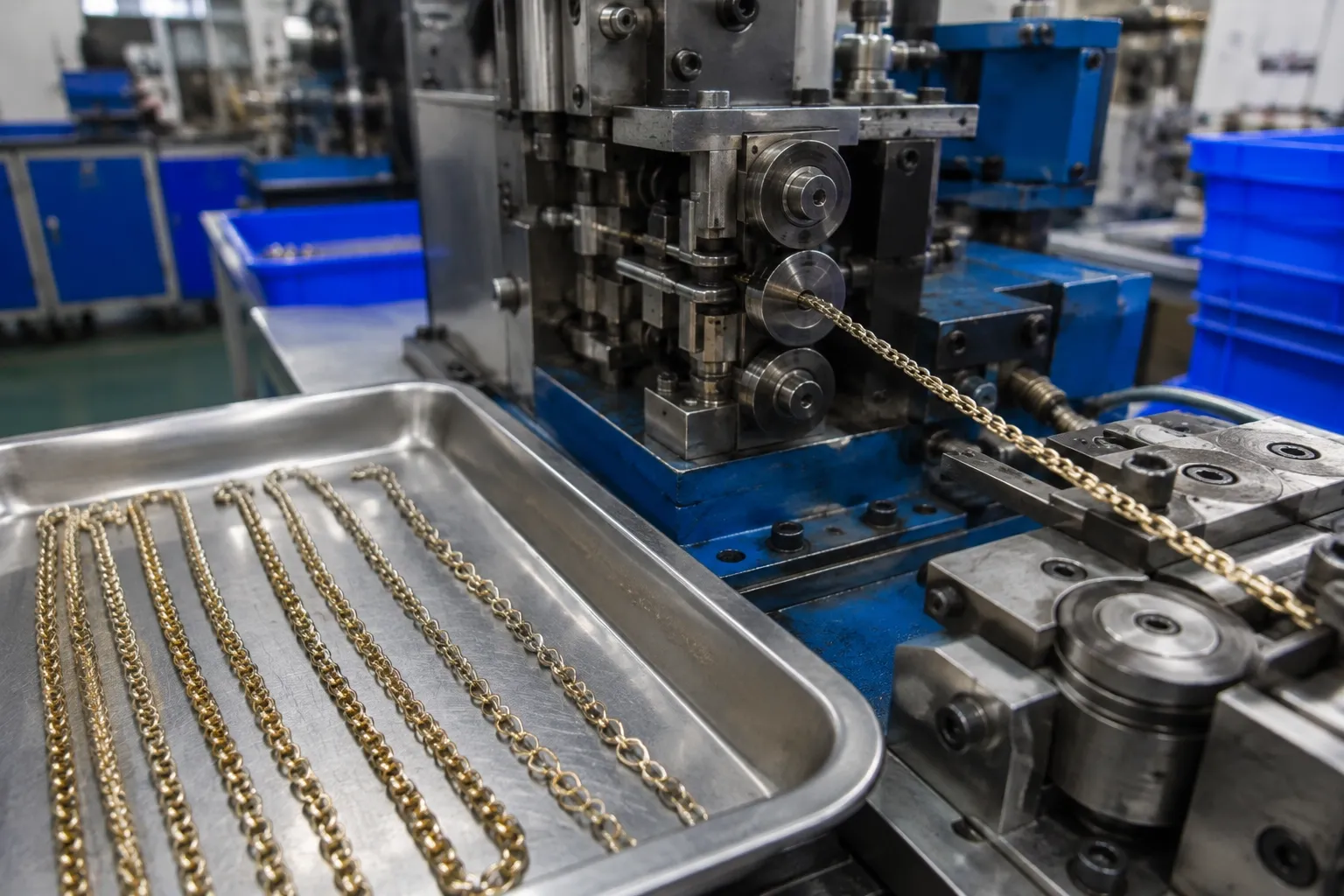
Chains
CAT-05Cable · Curb · Cuban · Box
- MOQ
- 500 pcs
- First choice
- 316L stainless steel
- Nickel limit
- 0.5 µg/cm²/week
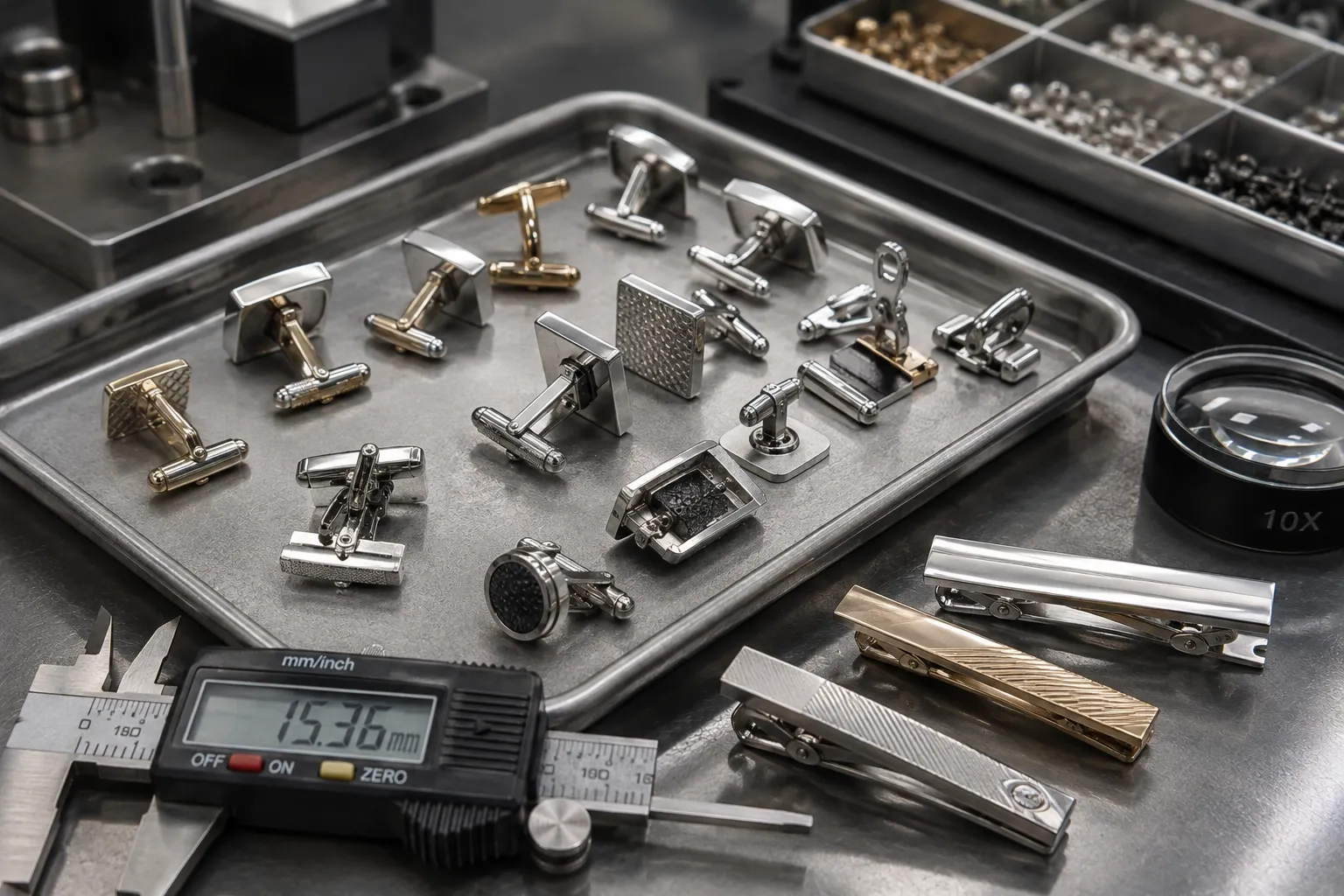
Cufflinks & Men's
CAT-06Bullet-back cufflinks · Whale-back cufflinks · Chain-link cufflinks · Fixed-back cufflinks
- MOQ
- 500 pcs
- First choice
- 316L stainless steel
- Nickel limit
- 0.5 µg/cm²/week
Category-specific mistakes
Common questions
Each answer stands alone and can be read without the rest of the page.
What is the MOQ for custom jewelry?
500 pieces per style, per plating colour, across every category. The per-colour part is what surprises buyers: each finish is a separate production batch with its own setup, so three colourways of one design is three batches of 500, not one batch of 500 split three ways.
Which jewelry category has the strictest compliance requirement?
Earrings. Anything passing through a pierced ear is limited to 0.2 µg/cm²/week of nickel release under REACH Annex XVII entry 27 — two and a half times stricter than the 0.5 µg/cm²/week limit that applies to rings, bracelets and necklaces in ordinary prolonged skin contact. That single figure eliminates most plated base metals from earring posts unless a nickel-free barrier is specified.
What information do you need to quote a jewelry order?
Category, material, quantity per style, finish with the plating thickness in microns, and the sizing dimensions for that category — ring size distribution, chain length and gauge, post diameter, cuff section, and so on. Sending these with the first enquiry is what turns a two-week back-and-forth into a one-working-day quotation.
Can one order mix several categories?
Yes, and it usually should — a coordinated range shares tooling concepts, plating batches and packing. Each style still carries its own MOQ and each finish its own batch, so a six-style range in two colours is twelve production batches. Consolidating finishes across styles lowers the total cost more than negotiating on any single line.
Do you make chain in-house or buy it in?
Chain is made on dedicated chain-making machines, which is a different process from the stamping and machining that produce pendants and findings. Where a component is bought in rather than made, it is stated in the quotation — and bought-in findings such as clasps and extenders must meet the same nickel-release standard as the body, because they are frequently where an otherwise compliant piece fails testing.
Which category is cheapest to launch a brand with?
Stamped stainless steel pieces in a single finish — flat pendants, discs, plain bands, tie bars. They carry the fewest labour operations, need no protective plating, and use tooling that is cheap relative to a die-cast or progressive die. The expensive launches are the ones with many styles, many sizes and many colourways, because each combination is its own batch.
Not answered here? All buyer questions →
Planning a range across several categories?
Send the style list, the materials and the quantities. You get an itemised price per style, the tooling cost as its own line, and a note on where consolidating finishes would cut the total.
- 01Reply within one working day, Guangdong business hours.
- 02Itemised cost sheet — mold quoted separately, not folded into the unit price.
- 03NDA on request before any file is shared.