
Which metal should your jewelry be made from?
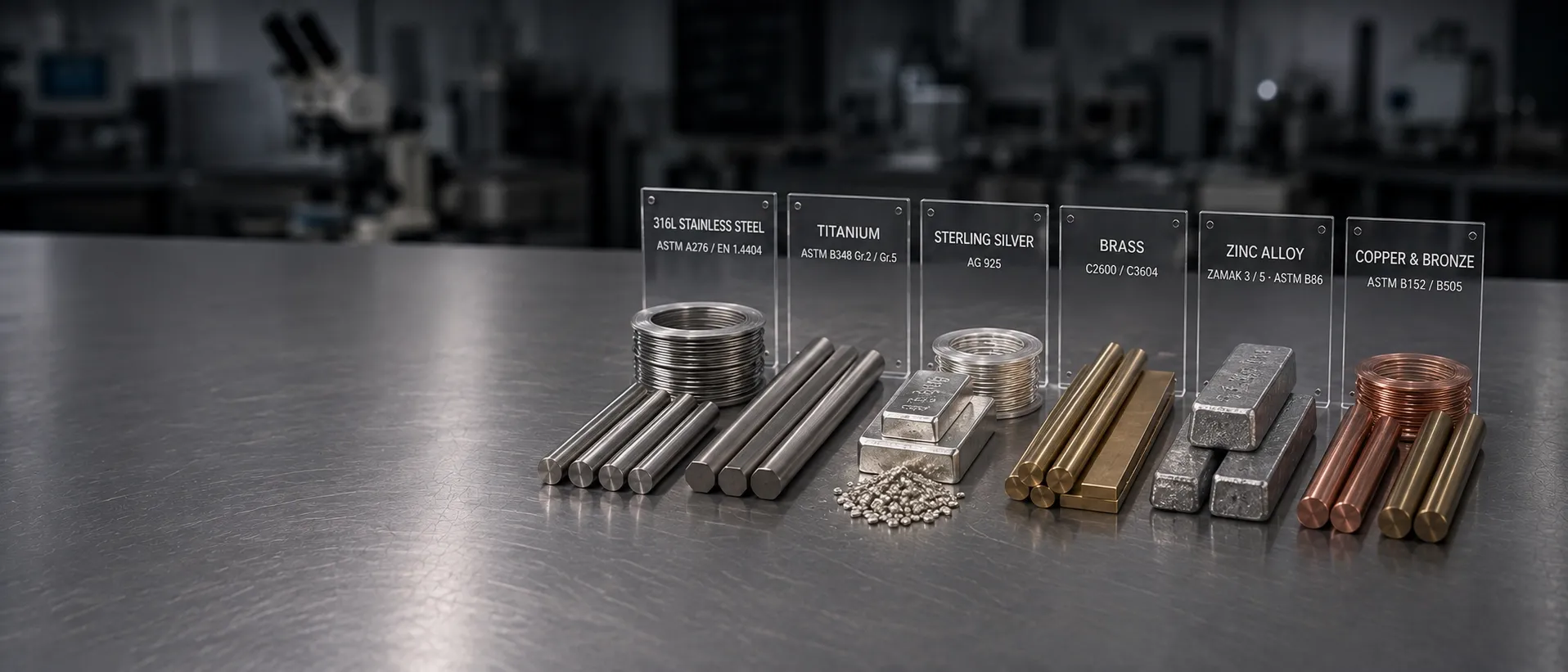
Composition, density, hardness and corrosion behaviour are published properties of each alloy, defined in ASTM and EN standards. They do not vary between suppliers, which makes them the only honest basis for choosing — and they decide far more about a range than appearance does, because plating makes most metals look alike on arrival.
Full comparison table
Every figure below is a property of the alloy as defined in its standard. Sort your decision on the column that matters for your product, not on the price column alone.
| Material | Standard | Density g/cm³ | Hardness HV | Corrosion | Raw cost | Nickel-safe bare | Best for |
|---|---|---|---|---|---|---|---|
| Stainless steel 316L | ASTM A276 / EN 1.4404 | 7.98 | 150–190 HV | Excellent | $$$$$ | Yes | Rings, chains, men’s pieces, everyday-wear earrings |
| Titanium (Grade 2 / Grade 5) | ASTM B348 Gr.2 / Gr.5 (Ti-6Al-4V) | 4.51 | 145 HV | Excellent | $$$$$ | Yes | Hypoallergenic studs and hoops, lightweight rings, implant-grade posts |
| Sterling silver 925 | ASTM B700 / EN ISO 9202 (925 fineness) | 10.36 | 60–80 HV | Tarnishes | $$$$$ | Yes | Fine jewelry, stone setting, pieces sold on metal value |
| Brass (C2600 / C3604) | ASTM B36 / EN CW508L | 8.47 | 95–130 HV | Tarnishes and patinas | $$$$$ | Plating-dependent | Plated fashion jewelry, enamel work, detailed cast charms |
| Zinc alloy (Zamak 3 / 5) | ASTM B86 (Zamak 3 / Zamak 5) | 6.6 | 80–100 HV | Poor bare | $$$$$ | Plating-dependent | Large decorative pieces, bag hardware, low-cost statement jewelry |
| Copper & bronze | ASTM B152 (Cu) / ASTM B505 (bronze) | 8.96 (Cu) · 8.8 (bronze) | 50–100 HV | Patinas | $$$$$ | Plating-dependent | Vintage and antique finishes, cast charms, heritage-look ranges |
Hardness is typical annealed or as-supplied Vickers and rises with cold work. Raw cost is a relative ranking of metal stock, not a quotation.
How to choose
Four questions settle the metal decision for almost every range. Answer them in this order — the first one eliminates the most options.
| Question | If yes | If no |
|---|---|---|
| Does it pass through a pierced ear? | Titanium or 316L — the 0.2 µg/cm²/week limit rules out plated base metals unless the barrier is nickel-free | The 0.5 µg/cm²/week limit applies; more options open up |
| Will it be worn daily and get wet? | 316L or titanium — no plating to wear through | Plated brass becomes viable |
| Does the design have fine organic detail or undercuts? | 925 silver or brass, cast — 316L is very hard to cast finely | Stamped or machined 316L is cheaper and tougher |
| Is the piece sold on its metal value? | 925 silver — accept that quotations expire with the spot market | Metal cost is a minor line; optimise for wear life instead |
Cost, and what it actually means
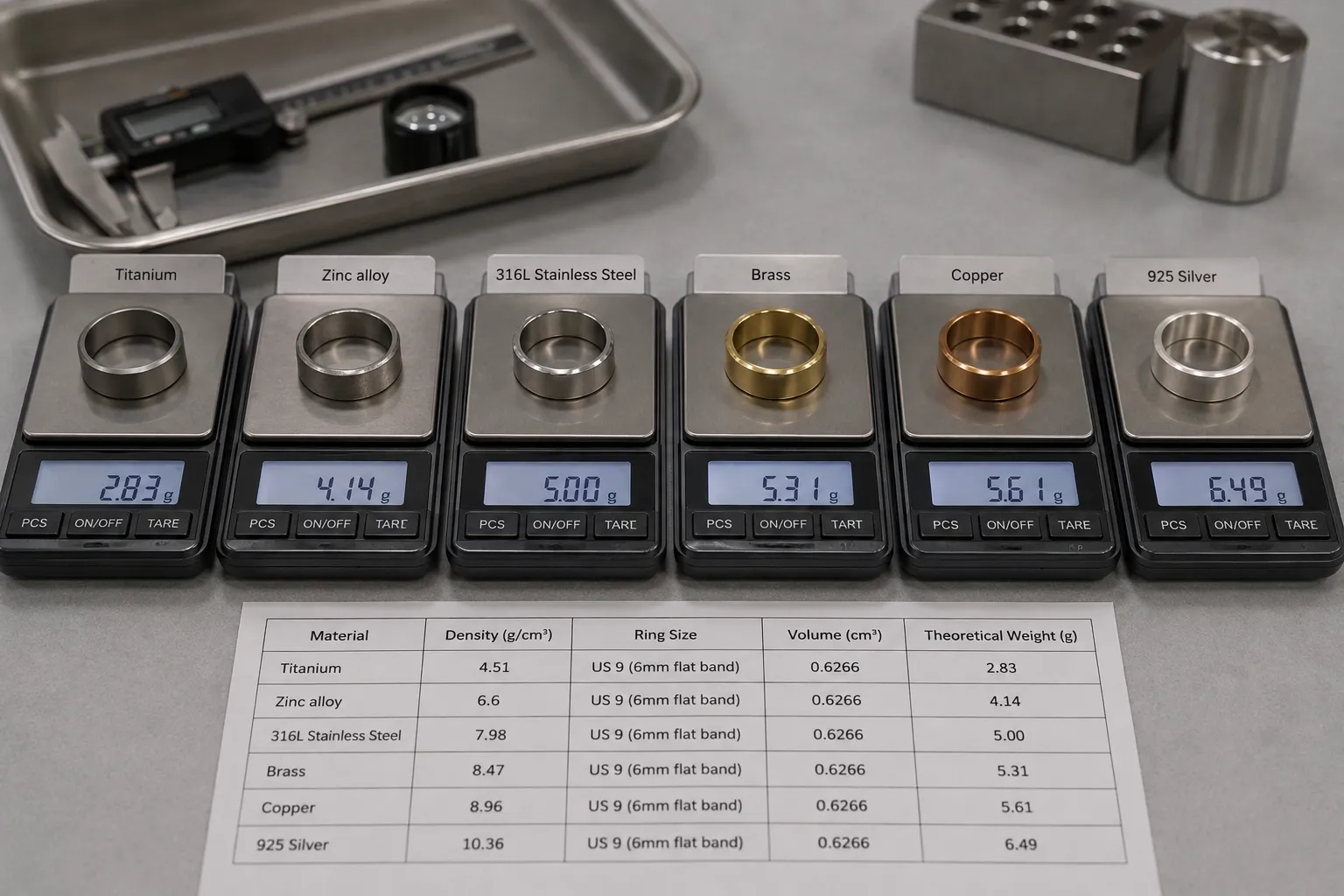
Raw metal price is the figure buyers compare, and it is rarely the figure that decides a unit price. Density converts price-per-kilo into price-per-piece, and on light components the conversion changes the ranking.
| Metal | Raw stock $/kg | Density g/cm³ | Priced against | Volatility |
|---|---|---|---|---|
| Zinc alloy (Zamak 3/5) | $3–5 | 6.6 | Stock list | Low |
| Stainless steel 316L | $3–6 | 7.98 | Stock list | Low |
| Brass C2600 | $7–10 | 8.47 | Copper-linked | Moderate |
| Copper / bronze | $9–12 | 8.96 (Cu) · 8.8 (bronze) | Copper market | Moderate |
| Titanium Gr.2 | $30–60 | 4.51 | Stock list | Low |
| Sterling silver 925 | $900–1,150 | 10.36 | Daily spot market | High — quotations expire |
Indicative ranges as of 2026-08, not a quotation. Silver and copper track daily markets; steel, titanium and zinc are stock-list priced and comparatively stable.
industry-typical
On a 6 g stainless steel ring the metal costs around three cents, and the price is decided almost entirely by labour, coating and tooling. On a 1.2 g pair of 925 silver studs the metal is more than half the price. That inversion is why the cost breakdown is worth reading before the metal is chosen, not after.
Nickel release by metal
EU law limits nickel release, not nickel content — 0.5 µg/cm²/week for prolonged skin contact and 0.2 µg/cm²/week for pierced ears, under REACH Annex XVII entry 27. That distinction produces results most buyers find counter-intuitive.
| Material | Contains nickel? | Releases nickel? | Safe for pierced ears? |
|---|---|---|---|
| 316L steel | Yes — 10–14% | Below the limit | Yes |
| Titanium | No, as an alloy | Below the limit | Yes |
| 925 silver | No, as an alloy | Below the limit | Yes |
| Brass | No, as an alloy | Depends on the plating barrier | Only with a nickel-free barrier |
| Zinc alloy | No, as an alloy | Depends on the plating barrier | Only with a nickel-free barrier |
| Copper / bronze | No, as an alloy | Depends on the plating barrier | Only with a nickel-free barrier |
A batch-specific EN 1811 report is what proves a particular production run complies — see EN 1811 compliance.
The six metals
Each page carries the full property table for that alloy, its finishing options, and the categories it suits.
316L steel
MAT-01Rings, chains, men’s pieces, everyday-wear earrings
- Standard
- ASTM A276
- Density
- 7.98 g/cm³
- Hardness
- 150–190 HV
- Nickel-safe
- Yes
Titanium
MAT-02Hypoallergenic studs and hoops, lightweight rings, implant-grade posts
- Standard
- ASTM B348 Gr.2
- Density
- 4.51 g/cm³
- Hardness
- 145 HV
- Nickel-safe
- Yes
925 silver
MAT-03Fine jewelry, stone setting, pieces sold on metal value
- Standard
- ASTM B700
- Density
- 10.36 g/cm³
- Hardness
- 60–80 HV
- Nickel-safe
- Yes
Brass
MAT-04Plated fashion jewelry, enamel work, detailed cast charms
- Standard
- ASTM B36
- Density
- 8.47 g/cm³
- Hardness
- 95–130 HV
- Nickel-safe
- Plating-dependent
Zinc alloy
MAT-05Large decorative pieces, bag hardware, low-cost statement jewelry
- Standard
- ASTM B86 (Zamak 3
- Density
- 6.6 g/cm³
- Hardness
- 80–100 HV
- Nickel-safe
- Plating-dependent
Copper / bronze
MAT-06Vintage and antique finishes, cast charms, heritage-look ranges
- Standard
- ASTM B152 (Cu)
- Density
- 8.96 (Cu) · 8.8 (bronze) g/cm³
- Hardness
- 50–100 HV
- Nickel-safe
- Plating-dependent
Common misconceptions
Common questions
Each answer stands alone and can be read without the rest of the page.
What is the best metal for jewelry that will be worn every day?
316L stainless steel, for most ranges. It does not tarnish, does not need a protective plating to be sold bare, does not stain skin, and at 150–190 HV it resists the deformation that softer metals suffer in daily wear. Titanium is better where weight or a diagnosed nickel allergy is the deciding factor; 925 silver is better where fine cast detail or stone setting matters more than durability.
Which jewelry metals are nickel-free?
Titanium is nickel-free by composition, and 925 sterling silver is nickel-free at that fineness. Brass, zinc alloy and copper are nickel-free as alloys but usually acquire nickel from the plating barrier layer sitting directly under the surface. 316L stainless steel contains 10–14% nickel yet passes EN 1811, because the alloy is austenitic and the nickel is bound in the crystal structure rather than free at the surface. What EU law limits is release, not content.
Why is titanium more expensive per kilogram but not always per piece?
Titanium's density is 4.51 g/cm³ against 7.98 for 316L, so the same shape uses roughly 44% less metal by weight. Raw titanium costs several times more per kilogram, but that multiplier applies to a much smaller mass. On small components the gap narrows considerably; on heavy chains and wide bands 316L stays substantially cheaper.
Which metal takes gold plating best?
Brass, because its surface chemistry accepts an electroplated layer readily and it is soft enough to form into detailed shapes first. Stainless steel takes plating too, but PVD is the better finish for it — the coating bonds harder than the base metal and lasts years rather than months. Zinc alloy plates acceptably but cannot take PVD at all, because a PVD chamber runs hotter than Zamak melts.
Does 925 silver tarnish, and can it be prevented?
Yes — silver reacts with airborne sulphur compounds and darkens. Rhodium plating over the silver prevents it effectively, and anti-tarnish barrier bags prevent it during transit and shelf storage. Unplated 925 shipped in ordinary poly bags will arrive with visible tarnish after a long sea freight, and buyers routinely mistake that for a quality failure.
What is the cheapest metal for custom jewelry?
Zinc alloy has the lowest raw-stock cost, and it die-casts large decorative shapes cheaply. The saving is partly illusory: zinc has poor bare corrosion resistance, so it depends entirely on its plating, it cannot take PVD, and it is not suitable for pierced-ear components. For flat or shallow shapes, stamped 316L often lands at a similar unit price with none of those limitations.
Not answered here? All buyer questions →
Not sure which metal your range needs?
Send the design, the market you ship to and the price you are targeting. We reply with two or three metal options priced side by side, and we will say plainly when the cheapest one is the wrong answer.
- 01Reply within one working day, Guangdong business hours.
- 02Itemised cost sheet — mold quoted separately, not folded into the unit price.
- 03NDA on request before any file is shared.