
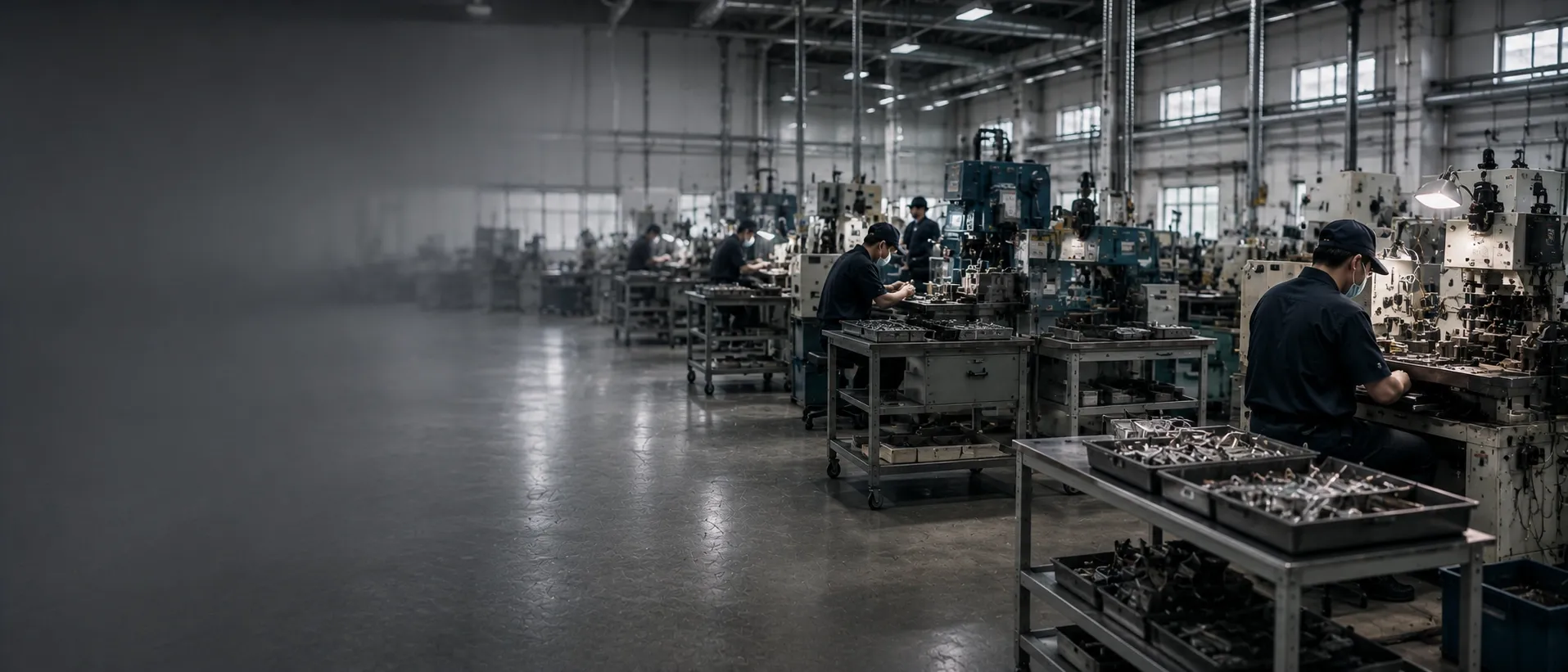
Which manufacturing process should your design use?
The forming route decides the tooling bill, the minimum quantity that makes economic sense, and whether the design can be made at all. Tolerance, minimum wall thickness and tooling cost are engineering properties of each process, so the comparison below holds at any competent factory.
All twelve processes compared
Tolerance, minimum wall and tooling cost are engineering properties of the process. They hold at any competent factory and can be checked against a manufacturing reference.
| Process | Tolerance | Min. wall | Tooling | Suits | Materials |
|---|---|---|---|---|---|
| Lost-wax casting | ±0.1–0.3 mm | 0.8 mm | $30–120 (silicone or rubber mold) | 100–10,000 pcs | 925 silver, Brass, Bronze, Zinc alloy |
| Stamping and die striking | ±0.05 mm | 0.3 mm | $150–2,000 (simple to progressive steel die) | 1,000–500,000 pcs | 316L stainless steel, Brass, Copper, Titanium |
| CNC machining | ±0.02 mm | 0.5 mm | None — programming and setup only | 1–2,000 pcs | 316L stainless steel, Titanium, Brass, 925 silver |
| Chain making | ±0.1 mm on link pitch | 0.5 mm wire | Machine setup per link style | Continuous lengths, cut to order | 316L stainless steel, 925 silver, Brass |
| Stone setting | ±0.05 mm on seat diameter | 0.4 mm around a bezel | None — skilled labour per stone | Any quantity | 925 silver, Brass, 316L stainless steel |
| Polishing and finishing | Removes 0.01–0.05 mm | Adds no material — thin sections can be polished through | None | Any quantity | All |
| Electroplating | ±20% on deposited thickness | n/a | None — bath setup per colour batch | Batches of one colour | Brass, Zinc alloy, 925 silver, Copper, 316L stainless steel |
| PVD and IP coating | ±0.1 µm on coating thickness | n/a | None — chamber batch | Batches of one colour | 316L stainless steel, Titanium |
| Gold-filled and vermeil | Gold-filled 5% by weight; vermeil ≥ 2.5 µm | 0.4 mm | As for the underlying forming route | 500–20,000 pcs | 925 silver (vermeil), Brass core (gold-filled) |
| Enameling | ±0.1 mm on fill depth | 0.3 mm cell wall | As for the forming route | 500–20,000 pcs | Brass, Copper, 925 silver, Zinc alloy |
| Frosted and Florentine finishing | Fixture- and geometry-dependent, validated per drawing | Adds no material but displaces it — thin sections can bruise or bow | None for full-area work; programming and a fixture per design once zones are specified | Any quantity, but per-piece time does not fall with it | 925 silver, Brass, Copper, Bronze, 316L stainless steel |
| Laser engraving and marking | ±0.01 mm positional | Marks 0.005–0.1 mm deep | None — file setup only | 1–50,000 pcs | 316L stainless steel, Titanium, Brass, 925 silver |
Tooling ranges are industry-typical. A firm figure is quoted against your CAD file — see the cost breakdown.
Choosing a forming route
Four forming routes turn raw metal into a shape. Everything else on this page is finishing, applied afterwards. Get this decision right and the rest follows.
| Route | Tolerance | Tooling | Operations | Choose it when |
|---|---|---|---|---|
| Lost-wax casting | ±0.1–0.3 mm | $30–120 (silicone or rubber mold) | 9 | Sculptural pendants, signet rings with relief, charms, anything with undercuts |
| Stamping and die striking | ±0.05 mm | $150–2,000 (simple to progressive steel die) | 6 | Tags, discs, coin pendants, flat signet faces, blanks for further forming |
| CNC machining | ±0.02 mm | None — programming and setup only | 6 | Plain and channel-set rings, precision components, titanium parts, prototypes |
| Chain making | ±0.1 mm on link pitch | Machine setup per link style | 6 | Twelve link styles in continuous lengths, 0.8–12 mm gauge |
Operation count drives the labour line, because labour is priced per operation rather than per piece.
Tooling cost by route
Tooling is a one-off charge for making the thing that makes the pieces. It is invoiced as its own line, never amortised into the unit price, and the buyer owns it.
| Tooling | Forming route | Cost | Lead time | Life |
|---|---|---|---|---|
| Silicone mold | Lost-wax casting | $30–80 | 2–4 days | ~500–1,000 wax injections |
| Vulcanised rubber mold | Lost-wax casting | $50–120 | 3–5 days | ~2,000–5,000 injections |
| Steel stamping die — simple | Stamping / die striking | $150–500 | 5–10 days | 100,000+ strikes |
| Steel stamping die — progressive | Stamping / die striking | $500–2,000 | 10–20 days | 100,000+ strikes |
| Die-casting die | Zinc alloy die casting | $600–2,500 | 15–25 days | 50,000–200,000 shots |
| No tooling | CNC machining | Programming & setup only | 1–3 days | n/a |
Lead time is tooling only and runs before sampling begins. Stamping dies are cut in our own wire EDM room, so a tooling revision does not queue behind an outside die shop.
industry-typical
Finishing routes compared
Finishing decides how the piece looks on arrival and how it looks after six months. These two are frequently not the same, and the gap between them is where returns come from.
| Route | What it does | Materials | Watch out for |
|---|---|---|---|
| Stone setting | Stones are secured mechanically into seats cut or cast into the metal — by prongs, a bezel wall, a channel, or micro-pavé beads raised from the surface. | 925 silver, Brass, 316L stainless steel | Setting is priced per stone and per setting type, so a pavé design with forty small stones costs far more in labour than one with a single large stone, regardless of stone value. |
| Polishing and finishing | Surface material is removed progressively by abrasives — in bulk by vibratory and magnetic media, or by hand at a bench wheel — until the specified finish is reached. | All | Plating and PVD amplify whatever surface they land on. |
| Electroplating | The piece is made the cathode in an electrolyte bath and metal ions are deposited onto it by an electric current, building a coating whose thickness is set by current and time. | Brass, Zinc alloy, 925 silver, Copper, 316L stainless steel | This is where nickel enters an otherwise nickel-free piece — the conventional barrier layer is nickel, and it sits directly under the surface that touches skin. |
| PVD and IP coating | In a vacuum chamber, a solid target is vaporised and the vapour condenses onto the piece as a ceramic compound — usually titanium nitride and its relatives — bonded at the atomic level. | 316L stainless steel, Titanium | Zinc alloy cannot take PVD. |
| Gold-filled and vermeil | Gold-filled bonds a karat gold layer to a base metal core under heat and pressure, at a minimum of 5% of total weight. | 925 silver (vermeil), Brass core (gold-filled) | Both terms are legally defined in the US — vermeil requires a sterling base and 2. |
| Enameling | Coloured glass frit or epoxy resin is filled into recessed cells in the metal and then fired or cured until it sets flush and hard. | Brass, Copper, 925 silver, Zinc alloy | Vitreous enamel fires above 750 °C, which rules out zinc alloy and any piece already plated. |
| Laser engraving and marking | A focused fibre laser removes or discolours a controlled depth of surface material, writing a permanent mark directly from a vector file. | 316L stainless steel, Titanium, Brass, 925 silver | Engraving after plating cuts through the coating and exposes the base metal at the mark. |
From inquiry to shipment
Six stages run between an inquiry and a shipped carton. Sampling takes about 10 days and bulk production about 25 days; tooling runs before both.
- 01
≤ 24 hInquirySpec sheet, sketch or CAD in. NDA on request first.
- 02
1–2 daysQuotationMaterial, labour, plating and tooling priced as separate lines.
- 03
2–5 days3D & toolingCAD signed off before any tooling is cut.
- 04
10 daysSamplingPhysical sample shipped for approval before bulk.
- 05
25 daysProductionIn-line QC during the run, not only at the end.
- 06
By incotermShipAQL inspection report travels with the shipment.
The twelve processes
Each page carries the full parameter table, the production steps, and a direct comparison with the alternative route buyers usually weigh it against.
Casting
PRC-01Sculptural pendants, signet rings with relief, charms, anything with undercuts
- Tolerance
- ±0.1–0.3 mm
- Min. wall
- 0.8 mm
- Suits
- 100–10,000 pcs
- On our floor
- Yes
Stamping
PRC-02Tags, discs, coin pendants, flat signet faces, blanks for further forming
- Tolerance
- ±0.05 mm
- Min. wall
- 0.3 mm
- Suits
- 1,000–500,000 pcs
- On our floor
- Yes
CNC
PRC-03Plain and channel-set rings, precision components, titanium parts, prototypes
- Tolerance
- ±0.02 mm
- Min. wall
- 0.5 mm
- Suits
- 1–2,000 pcs
- On our floor
- Yes
Chain
PRC-04Twelve link styles in continuous lengths, 0.8–12 mm gauge
- Tolerance
- ±0.1 mm on link pitch
- Min. wall
- 0.5 mm wire
- Suits
- Continuous lengths, cut to order
- On our floor
- Yes
Setting
PRC-05Cubic zirconia, moissanite, natural stones — prong, bezel, channel and pavé settings
- Tolerance
- ±0.05 mm on seat diameter
- Min. wall
- 0.4 mm around a bezel
- Suits
- Any quantity
Polishing
PRC-06Mirror, satin, brushed, bead-blast and matte finishes on any metal
- Tolerance
- Removes 0.01–0.05 mm
- Min. wall
- Adds no material — thin sections can be polished through
- Suits
- Any quantity
- On our floor
- Yes
Plating
PRC-07Gold, rose gold, rhodium and black finishes on brass, zinc alloy and silver
- Tolerance
- ±20% on deposited thickness
- Min. wall
- n/a
- Suits
- Batches of one colour
PVD
PRC-08Gold, rose gold, black and gunmetal on stainless steel — the finish for everyday wear
- Tolerance
- ±0.1 µm on coating thickness
- Min. wall
- n/a
- Suits
- Batches of one colour
Gold-filled
PRC-09Ranges sold on gold content, US market pieces where the terms carry legal meaning
- Tolerance
- Gold-filled 5% by weight; vermeil ≥ 2.5 µm
- Min. wall
- 0.4 mm
- Suits
- 500–20,000 pcs
Enamel
PRC-10Logo colour, flags, pattern work, colour-blocked ranges
- Tolerance
- ±0.1 mm on fill depth
- Min. wall
- 0.3 mm cell wall
- Suits
- 500–20,000 pcs
Frosting
PRC-12Sparkle without stones, frosted-then-plated ranges, and pieces that mix a textured face with polished bevels
- Tolerance
- Fixture- and geometry-dependent, validated per drawing
- Min. wall
- Adds no material but displaces it — thin sections can bruise or bow
- Suits
- Any quantity, but per-piece time does not fall with it
Engraving
PRC-11Brand logos, size and material stamps, serial numbers, personalised text
- Tolerance
- ±0.01 mm positional
- Min. wall
- Marks 0.005–0.1 mm deep
- Suits
- 1–50,000 pcs
- On our floor
- Yes
Common misconceptions
Common questions
Each answer stands alone and can be read without the rest of the page.
Should my design be cast or stamped?
Cast it if the form is three-dimensional, organic, or has undercuts a die cannot release. Stamp it if the shape is flat or shallow and the quantity justifies cutting a steel die. Stamping holds a tighter tolerance (±0.05 mm against ±0.1–0.3 mm), carries fewer labour operations and a lower scrap allowance, and costs far less per piece once running — but the die costs $150–2,000 against $30–120 for a casting mold, and it cannot be modified afterwards.
Which process holds the tightest tolerance?
CNC machining, at ±0.02 mm, because material is cut away under computer control rather than formed or poured. Stamping holds ±0.05 mm and lost-wax casting ±0.1–0.3 mm. Where a cast or stamped part needs a tighter feature than the process allows, the usual answer is a secondary machining operation on that feature rather than a change of primary route.
What is the minimum wall thickness for cast jewelry?
0.8 mm for lost-wax casting — below that, molten metal fails to fill the cavity reliably and the piece comes out with misruns. Stamping goes down to 0.3 mm because it forms sheet stock rather than filling a cavity, and CNC to 0.5 mm limited by tool deflection rather than material flow.
Which process needs no tooling at all?
CNC machining. It cuts directly from stock using a program generated from the CAD file, so there is nothing to pay for up front beyond programming and setup. That makes it the right route for the first hundred pieces, for designs still being revised, and for hard metals like titanium — and the wrong route above a few thousand pieces, because machine time is charged per piece and does not fall with quantity.
How long does the whole process take from inquiry to shipment?
Quotation within one working day, CAD and tooling 2–5 days, sampling about 10 days from an approved 3D file, and bulk production about 25 days after sample approval. Shipping sits outside those figures and depends on the incoterm. A progressive stamping die adds 10–20 days before sampling can begin.
Can one order use more than one process?
Almost every order does. A necklace is a cast or stamped pendant plus machine-made chain plus a plated finish plus laser engraving — four routes on four machines. What matters commercially is that each route carries its own setup, so consolidating an order into fewer routes and fewer finish variants lowers the unit price more than negotiating on any single line.
Not answered here? All buyer questions →
Not sure whether casting or stamping fits your design?
Send the sketch or the CAD file. We reply with both routes priced side by side — tooling and unit price separated — and a straight answer on which one the design actually wants.
- 01Reply within one working day, Guangdong business hours.
- 02Itemised cost sheet — mold quoted separately, not folded into the unit price.
- 03NDA on request before any file is shared.