
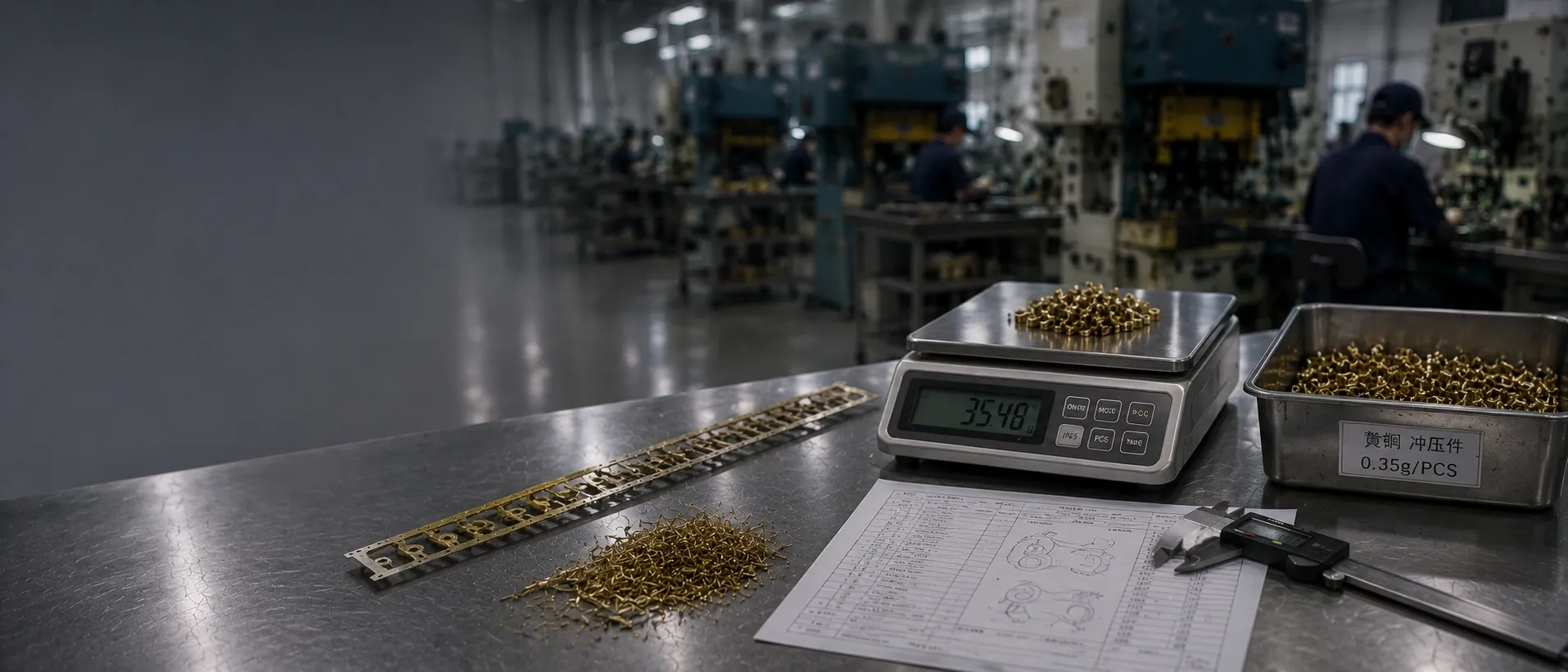
How much does custom jewelry manufacturing actually cost?
Almost every supplier answers this with "it depends on your design". That is true and useless. What a buyer needs is the structure of the price — which lines exist, which ones move with quantity, and which ones do not — so that two quotations can be compared like for like. This page gives that structure.
The six lines in a jewelry unit price
Every quotation, from every factory, is some arrangement of these six lines plus tooling. A supplier who will not break them out is not necessarily overcharging — but the buyer has no way to tell.
| Cost line | How it is calculated | Moves with quantity? | Typical share of unit price |
|---|---|---|---|
| Metal | Finished weight × metal price, plus scrap allowance | Barely — set by weight and market | 20–60%, depending on metal |
| Labour | Time per operation × operations, plus setup spread over the run | Strongly — setup is fixed per run | 15–40% |
| Plating / coating | Surface area × micron thickness × metal deposited | Weakly — bath prep is a fixed cost per batch | 10–35% |
| Finishing | Polishing, tumbling, assembly, engraving — priced per operation | Moderately | 5–20% |
| Packing | Pouch, box, card, barcode, carton | Weakly | 2–10% |
| Scrap allowance | A percentage uplift covering rejects and process loss | No — a percentage | 3–8% |
| Mold / tooling | One-off charge, quoted separately | Not in the unit price at all | Separate line |
Shares are indicative of how jewelry costing is structured across the industry, not a quotation. A 925 silver piece is metal-dominated; a heavily finished zinc-alloy piece is labour- and plating-dominated.
Metal cost
Metal cost is the one line a buyer can calculate independently: finished weight in grams, multiplied by the price of that metal, plus the scrap allowance. Weight comes from the CAD model, so it is known before anything is made.
Density is what makes this counter-intuitive. Titanium costs several times more per kilogram than 316L stainless steel, but its density is 4.51 g/cm³ against 7.98 — so the same shape in titanium uses about 44% less metal by weight. For small components the price gap narrows far more than the per-kilo figures suggest.
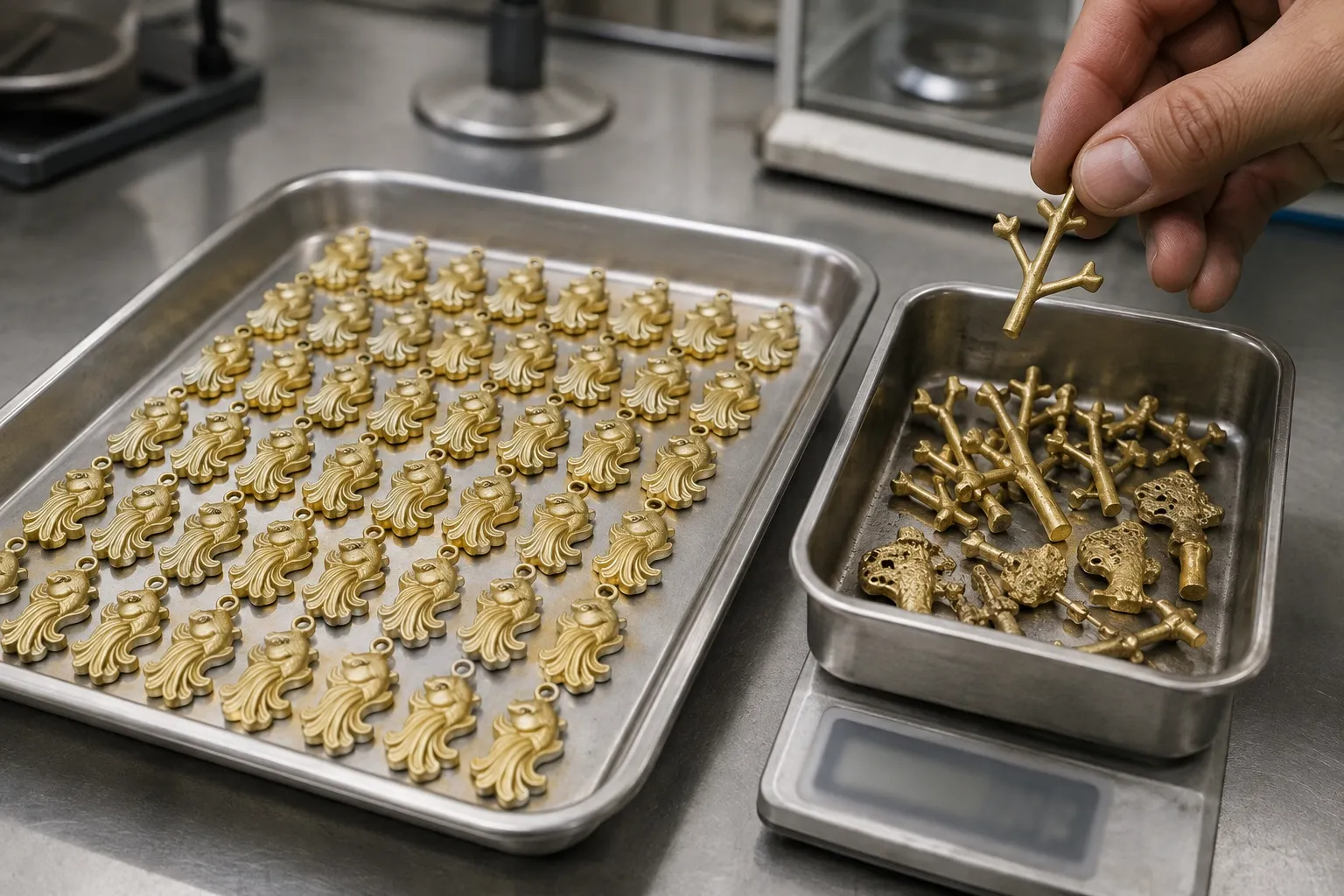
Two metals are priced against daily markets rather than stock lists: 925 silverand any solid gold. Quotations for those expire, usually within a few days, and a reorder three months later will legitimately carry a different metal line.
| Metal | Raw stock $/kg | Priced against | Volatility |
|---|---|---|---|
| Zinc alloy (Zamak 3/5) | $3–5 | Stock list | Low |
| Stainless steel 316L | $3–6 | Stock list | Low |
| Brass C2600 | $7–10 | Copper-linked | Moderate |
| Copper / bronze | $9–12 | Copper market | Moderate |
| Titanium Gr.2 | $30–60 | Stock list | Low |
| Sterling silver 925 | $900–1,150 | Daily spot market | High — quotations expire |
Indicative ranges for raw stock as of 2026-08, not a quotation. Silver and copper track daily markets and move; steel, titanium and zinc are stock-list priced and are comparatively stable. Metal is one line in a unit price — the worked examples below show it against the others.
industry-typical
Labour cost
Labour is priced per operation, not per piece. A ring that is cast, sprue-cut, pre-polished, stone-set, final-polished, plated and inspected carries seven labour lines; a stamped blank that is deburred and plated carries three. This is why a design's complexity moves the price far more than its size does.
Setup is the part that makes quantity matter. Preparing a stamping press, aligning a die, preparing a plating bath and running a first-article inspection cost the same whether the run is 200 pieces or 2,000. Spread across 200, setup can exceed the per-piece labour itself.
| Route | Typical operation count | Setup burden | Where it suits |
|---|---|---|---|
| Stamping / die striking | 3–5 | High setup, very low per-piece | Flat or shallow shapes at volume |
| Lost-wax casting | 6–9 | Moderate setup, high per-piece | Three-dimensional and organic shapes |
| CNC machining | 2–4 | Low setup, high per-piece machine time | Precision parts, hard metals, small runs |
| Chain making | 2–3 plus assembly | High setup per link style | Continuous lengths |
| Stone setting | +1 to +3 per stone type | Low setup, high skilled labour | Any route, added after forming |
Operation counts are typical for the route and exclude plating and packing, which are costed separately above.
Plating and coating cost
Plating is priced by surface area multiplied by deposited thickness in microns, times the cost of the metal being deposited. Colour matters only through that last term: gold is expensive, rhodium is expensive, black and gunmetal finishes are not.
Micron thickness is the single most abused number in jewelry sourcing. "18k gold plated" describes a colour, not a specification. The same phrase covers 0.1 µm, which wears through in weeks, and 1.0 µm, which lasts years — a tenfold difference in the gold actually deposited, and a large difference in price.
| Route | Typical thickness | Wear behaviour | Salt spray (ASTM B117) |
|---|---|---|---|
| Flash plating | 0.05–0.175 µm | Weeks | 8–16 h |
| Standard gold plating | 0.5–1.0 µm | Months to ~2 years | 16–24 h |
| Heavy gold plating | 2.5–5 µm | Several years | 24–48 h |
| Gold vermeil | ≥ 2.5 µm over 925 silver | Several years | 24–48 h |
| PVD / IP on 316L | 0.3–1.0 µm | Years | 48–96 h |
| 316L, uncoated | — | Indefinite | 96 h+ |
Salt-spray hours are neutral ASTM B117 exposure to first failure. The vermeil minimum of 2.5 µm is a legal definition under US FTC 16 CFR §23.5, not a supplier preference. Always specify microns in the purchase order — see PVD vs electroplating.
industry-typical
Tooling sits outside the unit price
Mold and tooling is a one-off charge for making the thing that makes the pieces. It should be quoted as its own line, invoiced separately, and owned by the buyer — so that a reorder two years later does not pay for it again.
When tooling is folded into the unit price it is amortised across an assumed quantity. The consequence surfaces later: a smaller reorder quietly costs more per piece, and the buyer has no line item to point at. Ask for tooling to be separated before comparing any two quotes.
Mold cost varies by the type of tooling the forming route needs, and the spread is wide: a silicone mold for casting and a progressive stamping die differ by more than an order of magnitude. The table below gives the range for each route.
| Tooling | Forming route | Cost | Lead time | Life | Notes |
|---|---|---|---|---|---|
| Silicone mold | Lost-wax casting | $30–80 | 2–4 days | ~500–1,000 wax injections | Cut around a 3D-printed or machined master. Cheapest route into casting; the master is the real cost driver. |
| Vulcanised rubber mold | Lost-wax casting | $50–120 | 3–5 days | ~2,000–5,000 injections | Tougher than silicone and holds dimension better over a long run. The default for repeat casting programmes. |
| Steel stamping die — simple | Stamping / die striking | $150–500 | 5–10 days | 100,000+ strikes | Single-station blank or emboss. Once cut, the per-piece labour is the lowest of any route. |
| Steel stamping die — progressive | Stamping / die striking | $500–2,000 | 10–20 days | 100,000+ strikes | Multi-station: blanks, forms and pierces in one press stroke. Only pays back at volume. |
| Die-casting die | Zinc alloy die casting | $600–2,500 | 15–25 days | 50,000–200,000 shots | Hardened steel, water-cooled. The highest tooling cost on the site and the lowest per-piece cost at scale. |
| No tooling | CNC machining | Programming & setup only | 1–3 days | n/a | Cut directly from stock. The correct route for small runs and for designs still changing. |
Tooling is invoiced as a one-off line and is never amortised into the unit price. Lead time is tooling only and runs before sampling begins.
industry-typical
| Charged as | A separate one-off line, never inside the unit price |
|---|---|
| Ownership | The buyer — tooling is stored under the buyer’s account |
| Reorder | No second tooling charge for the same design |
| Design ownership | The buyer’s; NDA signed before files are received |
| Stamping dies | Cut in our own wire EDM room, so a tooling revision does not queue behind an outside die shop |
| MOQ | 500 pcs per style, per plating colour |
Worked examples
Three orders costed line by line, ex-works, tooling excluded. The point is not the totals — it is which line dominates each one, because that is what tells a buyer where to push.
- Metal — 6 g @ $5/kg
- $0.03
- Labour — stamping, 4 operations
- $0.30–0.55
- PVD gold 0.5 µm
- $0.30–0.60
- Finishing — deburr, polish
- $0.15–0.30
- Packing — bag + card
- $0.05–0.15
- Scrap allowance 5%
- $0.04–0.08
- Unit price
- $0.87–1.71
- Tooling, one-off
- Steel die, $150–500 one-off
The metal in a stainless steel ring costs about three cents. Everything else in the price is labour, coating and tooling — which is why quantity, not material, moves a 316L quote.
- Metal — 4 g @ $8.50/kg
- $0.03
- Labour — casting, 7 operations
- $0.60–1.10
- Gold plating 1 µm + Ni-free barrier
- $0.35–0.90
- Finishing — sprue cut, polish
- $0.20–0.40
- Packing — pouch
- $0.05–0.15
- Scrap allowance 7%
- $0.08–0.18
- Unit price
- $1.31–2.77
- Tooling, one-off
- Vulcanised rubber mold, $50–120 one-off
Casting costs roughly twice the labour of stamping because it carries seven operations instead of four, and it needs a higher scrap allowance for sprues and porosity. Tooling, however, is a fraction of a steel die.
- Metal — 1.2 g @ ≈ $1,000/kg
- $1.20
- Labour — casting + assembly
- $0.45–0.85
- Rhodium plating
- $0.15–0.35
- Anti-tarnish packing
- $0.10–0.25
- Scrap allowance 5% (silver recovered)
- $0.09–0.13
- Unit price
- $1.99–2.78 per pair
- Tooling, one-off
- Silicone mold, $30–80 one-off
Metal is over half the price and it tracks the daily silver spot market, so a 925 quotation expires — usually within days. Reordering three months later legitimately costs a different amount.
What actually moves the price
| Variable | Effect on unit price | Why |
|---|---|---|
| Order quantity | Very high below ~1,000 pcs | Setup and first-article costs are fixed per run |
| Number of operations | Very high | Labour is priced per operation, not per piece |
| Plating thickness (microns) | High | Deposited metal scales linearly with thickness |
| Metal choice | High for silver, low for steel and zinc | Silver is spot-priced; steel and zinc are stock-priced |
| Finished weight | Moderate | Sets the metal line directly |
| Surface area | Moderate | Sets the plating line, independently of weight |
| Stone setting | Moderate to high | Skilled labour, priced per stone and per setting type |
| Finish variants per style | Moderate | Each plating colour is a separate batch with its own setup |
| Packing specification | Low to moderate | Custom boxes and cards can exceed the piece cost on cheap items |
| Compliance testing | Low per piece, fixed per batch | Amortised across the run; see the compliance pages |
Where buyers lose money
Questions buyers ask about this
Each answer is self-contained and can be read without the rest of the page.
Why do two jewelry quotations for the same design differ so much?
Almost always because the two suppliers assumed different plating thickness, different metal grade, or a different scrap allowance — and because one folded the mold cost into the unit price while the other quoted it separately. A quote of "$1.80/pc, 18k gold plated" and one of "$2.60/pc, 18k gold plated" can describe 0.1 µm and 1.0 µm of gold, a tenfold difference in the material that determines how long the colour lasts. Compare quotations only after fixing the grade, the micron thickness and the tooling treatment in writing.
How much does a jewelry mold cost?
It depends entirely on the forming route. A silicone mold for lost-wax casting is the cheapest tooling in jewelry at roughly $30–80 and takes 2–4 days; a vulcanised rubber mold runs about $50–120 and survives a far longer production life. Stamping needs a cut steel die — around $150–500 for a simple single-station die and $500–2,000 for a progressive die that blanks, forms and pierces in one stroke. A zinc die-casting die is the most expensive at roughly $600–2,500. CNC machining needs no tooling at all, only programming and setup, which is why it suits small runs and designs that are still changing.
Is mold cost included in the price per piece?
It should not be, and at OEM Jewelry Lab it is not. Tooling is a one-off charge invoiced as its own line, so the buyer can see it, own it, and reuse it on repeat orders without paying twice. When a supplier folds tooling into the unit price it is amortised across an assumed quantity — which means a smaller reorder silently costs more per piece, and the buyer never finds out why.
How much does quantity change the unit price of custom jewelry?
Metal cost per piece barely moves with quantity, because it is set by weight and market price. Labour and setup cost per piece fall sharply, because the same machine setup, the same plating bath preparation and the same first-article inspection are spread across more pieces. In practice the steep part of the curve is between roughly 100 and 1,000 pieces; beyond a few thousand the curve flattens because metal dominates.
What is a normal scrap or loss allowance in jewelry production?
Typically 3–8% depending on process and material. Lost-wax casting carries the highest allowance because sprues, misruns and porosity losses are inherent to the process; stamping carries a lower one because sheet offcuts are recoverable. A quotation with no scrap allowance at all is either hiding it inside another line or has not been costed properly.
Does plating cost depend on the piece size or on the plating colour?
On size, and specifically on surface area, multiplied by the specified thickness in microns. Colour affects cost only through which metal is deposited — gold costs far more than rhodium-grey or black. A large hollow pendant and a small solid ring of the same weight can differ substantially in plating cost because their surface areas differ.
Should a buyer give the supplier a target price?
Yes, if the target is realistic. A stated target lets the supplier engineer toward it — thinner stock, a simpler finish, a different forming route, a lower plating micron — and say plainly which trade-offs it requires. Without a target the supplier guesses at a specification, and the resulting quotation often answers a question the buyer did not ask.
Not answered here? All buyer questions →
Get the number for your actual order
The ranges on this page are the structure. A quotation puts your design, quantity, material and finish into it and returns a single itemised figure.
- 01Reply within one working day, Guangdong business hours.
- 02Itemised cost sheet — mold quoted separately, not folded into the unit price.
- 03NDA on request before any file is shared.