
What does California Prop 65 require for imported jewelry?
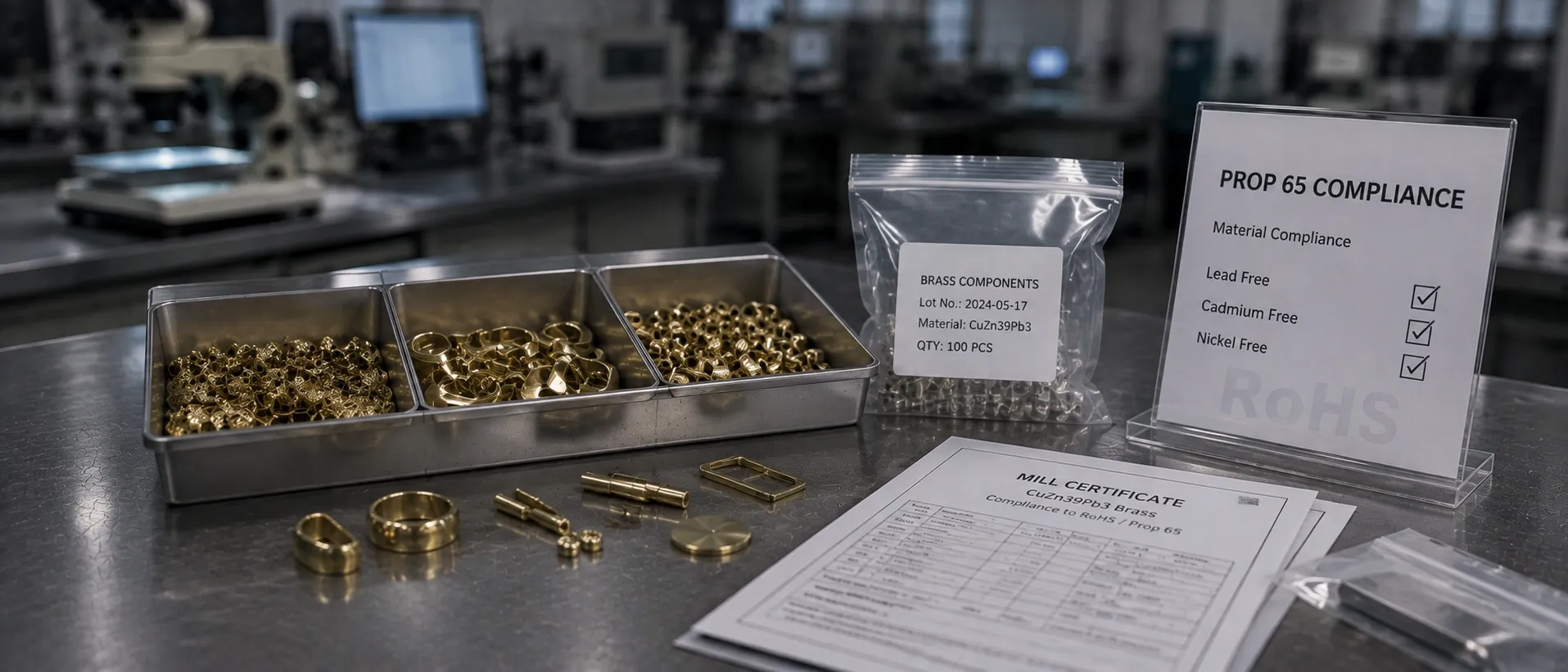
California regulates jewelry through two overlapping mechanisms: a materials law that sets hard composition limits on lead and cadmium, and Proposition 65 itself, which requires a warning when a product exposes a consumer to a listed chemical. Most enforcement actions against imported jewelry begin with a lab test of a component nobody thought about — a clasp, a solder joint, or a plating bath.
Two separate regimes
Buyers routinely treat these as one rule. They are two, they work differently, and a product can satisfy one while failing the other.
| Jewelry materials law | Proposition 65 | CPSIA | |
|---|---|---|---|
| Authority | CA Health & Safety Code §25214.1 | CA Health & Safety Code §25249.6 | Federal, enforced by the CPSC |
| Type of rule | Hard composition limit | Warning requirement | Hard composition limit |
| Applies to | All jewelry sold in California | All consumer products sold in California | Children's products nationwide |
| Lead | 600 ppm materials · 200 ppm coatings | Warning above 0.5 µg/day exposure | 100 ppm total in accessible substrate |
| Cadmium | 300 ppm in children's jewelry | Warning above safe-harbour level | Referenced through ASTM F2923 |
| Enforced by | State enforcement | Private plaintiffs | CPSC recalls and penalties |
Prop 65 enforcement is predominantly private-plaintiff driven, which is why exposure is commercial as well as regulatory. Selling into California means these apply regardless of where the product was made.
The limits
Composition limits are measured in parts per million of the material or coating. Prop 65's threshold is measured differently — as daily exposure, not concentration.
| Substance | Product type | Limit | Basis |
|---|---|---|---|
| Lead | Adult jewelry — most materials | 600 ppm | CA jewelry materials law |
| Lead | Adult jewelry — surface coatings | 200 ppm | CA jewelry materials law |
| Lead | Children's products — accessible substrate | 100 ppm | CPSIA, federal |
| Lead | Children's products — paint and coatings | 90 ppm | CPSIA, federal |
| Lead | Any consumer product | 0.5 µg/day exposure triggers a warning | Prop 65 safe harbour |
| Cadmium | Children's jewelry | 300 ppm | CA law and ASTM F2923 |
| Cadmium | Any consumer product | 4.1 µg/day exposure triggers a warning | Prop 65 safe harbour |
Prop 65 safe-harbour levels are exposure thresholds published by OEHHA, not composition limits. A high-lead component that is never in contact with skin can still trigger a warning obligation if exposure occurs.
Where lead actually comes from
Failures rarely involve the material a buyer specified. They involve the component that was never discussed.
| Source | Typical lead content | Why it is there | Fix |
|---|---|---|---|
| Free-machining brass (C3604) | 1.8–3.7% — 18,000–37,000 ppm | Lead is added deliberately to improve machinability | Specify a lead-free grade such as C2600 in writing |
| Leaded solder at joints | Up to 40% | Traditional low-melting-point solder | Require lead-free solder or laser welding |
| Low-grade zinc alloy | Variable, often high | Recycled feedstock of unknown origin | Specify Zamak 3 or 5 to ASTM B86 with a mill certificate |
| Bought-in findings | Unknown unless tested | Clasps, jump rings and posts sourced separately | Hold findings to the same standard as the body, in the PO |
| Plating bath contamination | Trace to significant | Carry-over in a shared or poorly maintained bath | Require coating-layer testing, not only substrate testing |
| Crystal and glass components | Historically high in leaded crystal | Lead oxide raises refractive index | Specify lead-free crystal or cubic zirconia |
Cadmium
Cadmium entered jewelry regulation because manufacturers substituted it for lead when lead limits tightened. It is more toxic, and the limits are correspondingly strict.
When the CPSIA cut permissible lead levels, some manufacturers replaced lead with cadmium in low-cost cast jewelry — cadmium has similar density and casting behaviour and was unregulated at the time. Regulators closed that gap quickly.
Children's jewelry is now limited to 300 ppm cadmium in California and is addressed by ASTM F2923, the consumer safety specification for children's jewelry. The Prop 65 safe-harbour exposure level is 4.1 µg/day.
Cadmium is not deliberately added to any alloy specified on this site. Where it appears, it arrives through recycled zinc or brass feedstock of unverified origin — which is why a mill certificate for the batch is worth more than a general assurance.
When a warning is required
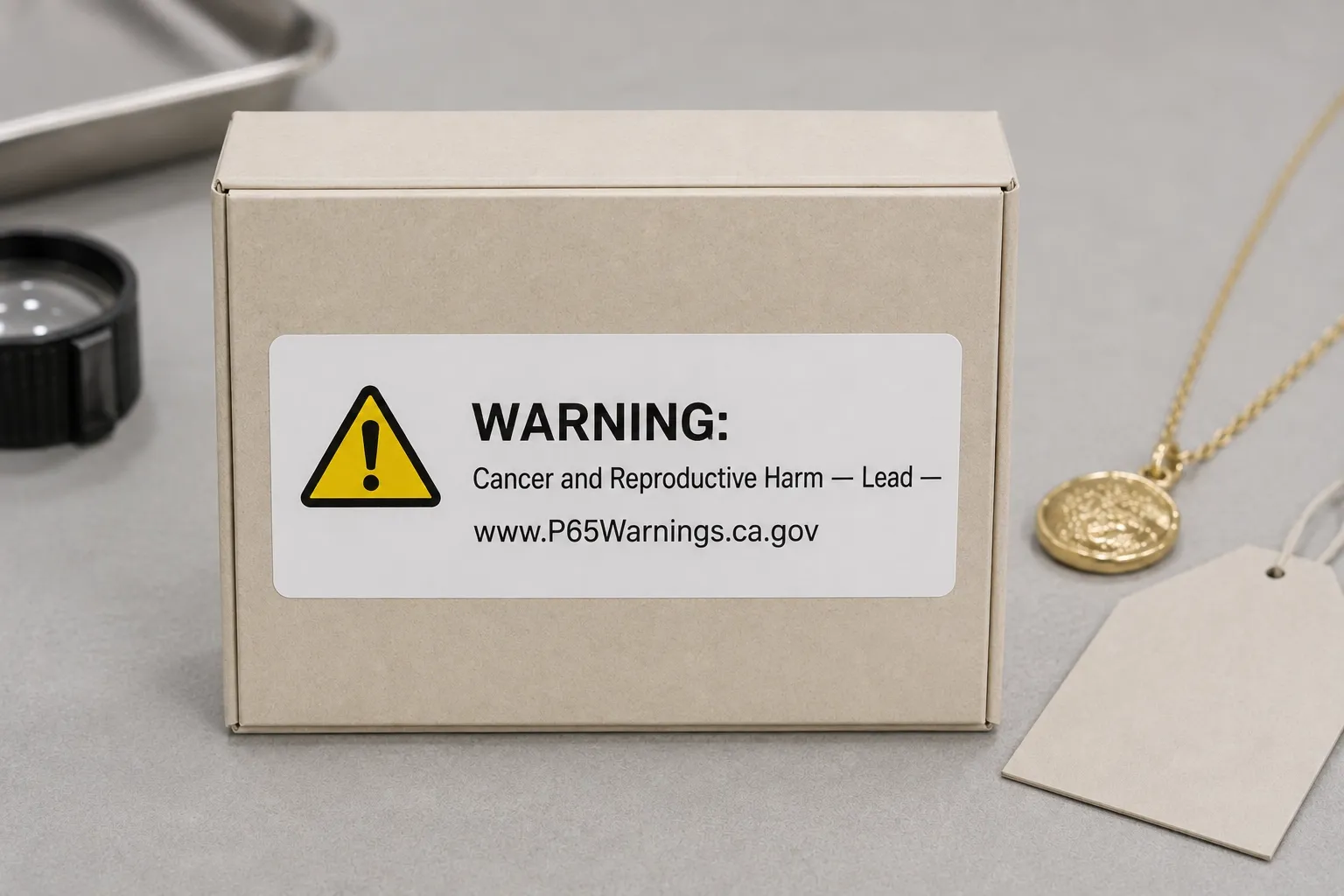
Prop 65 does not prohibit a substance. It requires a clear and reasonable warning when exposure exceeds the safe-harbour level — and warning has commercial consequences that compliance does not.
| Situation | Warning required? | Commercial consequence |
|---|---|---|
| Exposure below the safe-harbour level | No | No restriction |
| Exposure above safe harbour, warning applied | Yes — warning discharges the obligation | Several marketplaces and retailers reject warned products |
| Exposure above safe harbour, no warning | Non-compliant | Private-plaintiff enforcement exposure |
| Warning applied defensively without testing | Legally protective | Same channel restrictions, with no data to negotiate them away |
A warning is legally protective but commercially costly. Specifying lead-free alloys and coatings from the outset usually costs less than the retail access a warning closes off.
By material
Which alloys carry lead or cadmium risk by their nature, before any finishing is applied.
| Material | Lead risk | Cadmium risk | Specification that removes the risk |
|---|---|---|---|
| 316L stainless steel | None — no lead in the alloy | None | ASTM A276 grade designation |
| Titanium | None | None | ASTM B348 Gr.2 or Gr.5 |
| 925 silver | Low — check solder joints | None | Lead-free solder or laser welding |
| Brass | High in free-machining grades | Low | Lead-free grade such as C2600, in writing |
| Zinc alloy | Variable — depends on feedstock | Variable | Zamak 3 or 5 to ASTM B86, with a mill certificate |
| Copper & bronze | Low to moderate depending on grade | Low | Specify the grade and require a certificate |
A mill certificate for the production batch is what turns a material claim into evidence. Ask for it at order stage rather than after a lab result.
What to specify in the purchase order
Every line below costs nothing to add and prevents the great majority of lead and cadmium failures.
| Alloy grade | Named designation with its standard, e.g. C2600 to ASTM B36 |
|---|---|
| Lead-free brass | Explicitly excluded free-machining grades such as C3604 |
| Solder | Lead-free solder, or laser welding instead of solder |
| Coatings | ≤ 200 ppm lead in the surface coating layer |
| Findings | Clasps, posts, jump rings and extenders held to the same limits |
| Children’s products | 100 ppm total lead, 300 ppm cadmium, ASTM F2923 |
| Testing | Which components are tested, by which laboratory, at whose cost |
| Documentation | Mill certificate for the batch, not a generic assurance |
Third-party testing is arranged on request. Which standards apply, what the laboratory charges and how long it takes depend on the market, the material and the batch size, so both are confirmed in writing in the quotation rather than quoted generically.
Common misconceptions
Questions buyers ask about this
Each answer is self-contained and can be read without the rest of the page.
What is the lead limit for jewelry sold in California?
California's jewelry materials law (Health and Safety Code §25214.1 et seq.) limits lead to 600 ppm in most jewelry materials and 200 ppm in surface coatings such as plating and paint. For children's products the federal CPSIA limit of 100 ppm total lead in accessible substrate applies and is stricter. Proposition 65 operates separately: it does not set a composition limit at all, but requires a warning where exposure exceeds the safe-harbour level of 0.5 µg of lead per day.
Which jewelry materials most often fail Prop 65 lead testing?
Free-machining brass is the most frequent cause. Grades such as C3604 contain lead deliberately — typically 1.8–3.7% — because it improves machinability, and that is thousands of times over the 600 ppm limit. Low-grade zinc alloy, leaded solder at joints, and bought-in findings such as clasps and jump rings are the next most common. The decorative body of a piece usually passes; the component nobody specified is what fails.
Does Prop 65 apply to jewelry made outside the United States?
Yes. Proposition 65 applies to products sold or offered for sale in California regardless of where they were manufactured, and enforcement is typically brought by private plaintiffs rather than by a state agency. An importer or brand selling into California carries the exposure, which is why the specification needs to be right at the purchase order rather than discovered after a test.
What is the difference between Prop 65 and the CPSIA?
The CPSIA is federal law and sets a hard composition limit — 100 ppm total lead in accessible substrate for children's products — enforced by the CPSC. Prop 65 is a California right-to-know law: it sets no composition limit, but requires a clear and reasonable warning where a product exposes a person to a listed chemical above the safe-harbour level. A product can comply with the CPSIA and still require a Prop 65 warning, and vice versa.
Is a Prop 65 warning label a bad thing to put on jewelry?
It is a commercial decision rather than a compliance failure. A warning is legally protective, and many large retailers apply them defensively. But several major marketplaces and retail buyers reject warned products outright, so a warning can close distribution channels. Specifying lead-free alloys and coatings from the outset usually costs less than the retail access it preserves.
Which alloy should I specify to avoid lead problems entirely?
316L stainless steel or titanium — neither contains lead as an alloying element, and both pass lead and cadmium limits by composition. Where brass is needed for its formability or its plating behaviour, specify a lead-free grade such as C2600 in writing rather than accepting "brass", and require the same standard from every bought-in finding.
Not answered here? All buyer questions →
Get the number for your actual order
The ranges on this page are the structure. A quotation puts your design, quantity, material and finish into it and returns a single itemised figure.
- 01Reply within one working day, Guangdong business hours.
- 02Itemised cost sheet — mold quoted separately, not folded into the unit price.
- 03NDA on request before any file is shared.